February 15, 2026
On-Site Power: Why Data Centers Are Done Waiting for the Grid
The grid can't keep up with data center growth. On-site power generation with natural gas, solar, and batteries has shifted from temporary workaround to permanent infrastructure strategy — especially for edge deployments where modular data centers deploy in months instead of years.
The grid can't keep up. Data centers are adding capacity five to seven times faster than utilities can build new generation. That gap has existed for eight years and it's widening.
So the industry stopped waiting.
The Bridging Solution That Became Permanent
KC Mares from Megawatt Consulting put it plainly: "We're exceeding the ability of the grid to build new generation, new transmission. On-site generation isn't just a bridging solution anymore."
The math is brutal. Building a transmission line takes 7-10 years. The last major nuclear plant in the US (Vogtle 3 and 4) took 17 years and $37 billion to deliver 2.2 gigawatts. Meanwhile, a single hyperscale AI campus now demands that same capacity.
Nobody's waiting a decade for grid access when workloads need to spin up in months.
Natural Gas: The Unsexy Answer That Actually Works
In the US, on-site generation means natural gas turbines and engines. Not because it's exciting – because it works at scale, today.
About 10-12 gigawatts of on-site generation equipment was purchased this year alone for data centers. That's already half the total annual manufacturing capacity of 20 gigawatts. Lead times have stretched from under a year to 18+ months as demand outpaces supply.
The economics make sense. Natural gas generation at 2-3 cents per kWh beats waiting years for uncertain grid capacity. Modern gas turbines run at 50% efficiency – far better than the 30-year-old thermal plants averaging across the US grid.
And here's what nobody says out loud: on-site natural gas generation produces lower net emissions than drawing from most regional grids. The equipment is newer, more efficient, and sized precisely to the load instead of running massive baseload plants at partial capacity.
Europe's Different Calculus: Solar Actually Wins
European electricity prices flip the entire equation.
When grid power runs €0.15-0.25/kWh, solar starts looking less like environmentalism and more like basic financial sense. Chinese solar manufacturing drove panel costs so low that renewables became the cheapest form of energy – not in theory, in deployed cost per kWh.
Microsoft's $10 billion data center investment in Portugal isn't romantic. It's math. Portugal runs 72% renewable energy already, which means clean power at lower cost and faster permitting than trying to build capacity in constrained markets.
Why Modular Changes Everything
Traditional data center construction takes 18-24 months of on-site work. You can't start building until site prep finishes. You're coordinating multiple vendors for cooling, UPS, fire suppression – each with their own lead times and installation dependencies.
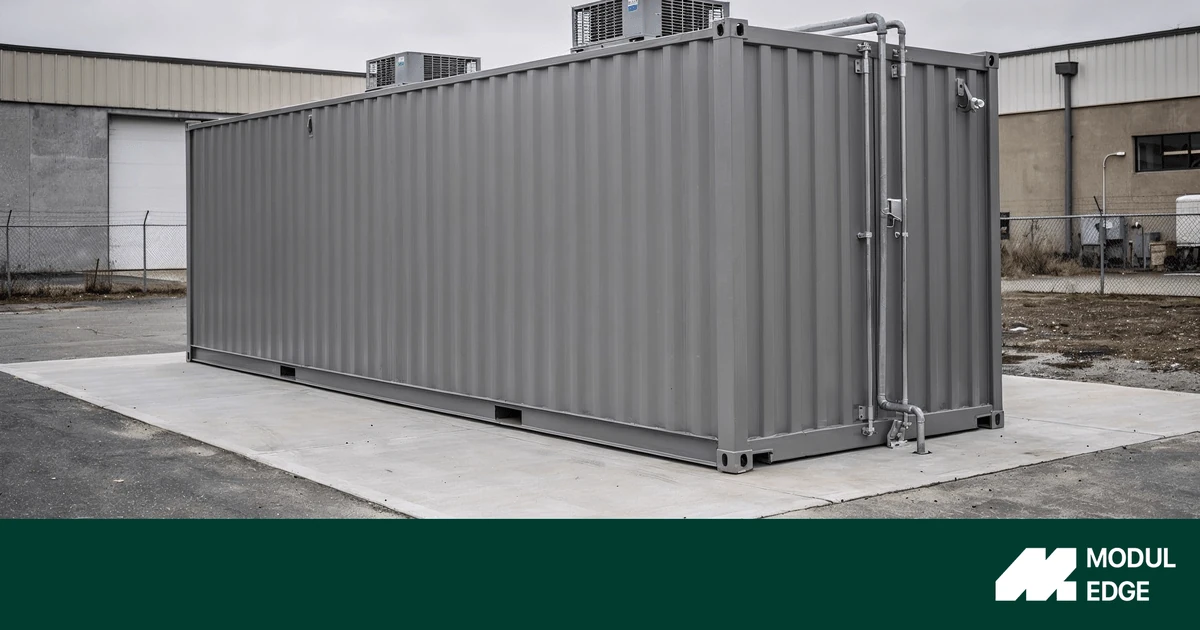
Modular data centers flip this. Factory-built systems arrive with power, cooling, and monitoring pre-integrated. While you're pouring the concrete pad, the modules are being manufactured in parallel. Commissioning happens in days instead of quarters.
For on-site generation, this matters more than it seems. A modular approach lets you match generation capacity to actual load in steps rather than overbuilding for theoretical peak demand. You start with what you need today and add modules as workload grows – whether that's solar arrays, battery storage, or gas gensets.
The Battery Question Everyone Asks
Can batteries solve intermittency and make renewables viable for 24/7 data center loads?
They're getting there faster than most people realize.
In the first half of 2024, the US grid added nearly 4.5 gigawatts of battery storage – almost a quarter of all new capacity. That battery capacity is growing because it makes solar and wind projects more economical, not less. Extending solar generation into evening peak hours through 4-hour battery systems changes the financial model entirely.
For data centers, medium-voltage battery systems do more than store renewable energy. They smooth the variability between generation and compute workload. On-site gas turbines handle baseload efficiently, but batteries absorb the rapid swings when AI inference workloads spike from 10% to 90% utilization in seconds.
What This Means for Edge Infrastructure
The shift to on-site power accelerates the move to edge deployments.
If you're generating power locally anyway, why constrain yourself to hyperscale campus locations near major grid interconnects? Edge compute for industrial sites, telecom aggregation points, and remote infrastructure suddenly makes more sense when power generation travels with the deployment.
This is where modular data centers (MDCs) stop being a niche solution and become the practical answer. A containerized module with integrated cooling and monitoring doesn't care if it's connected to a utility or fed by on-site generation. The same 40-150 kW/rack density that supports edge AI inference works whether you're pulling from a solar array in Spain or gas gensets in Texas.
The deployment cycle matters. Three to six months from engineering to commissioning means you can match infrastructure delivery to power availability instead of waiting years for grid capacity that may never arrive.
The Grid Isn't Going Away
On-site generation doesn't mean abandoning the grid. It means changing the relationship.
Several utilities told KC Mares they couldn't provide power for 10 years – then immediately offered capacity if the data center could self-supply for a few hundred hours per year during peak demand. That's easy to do with on-site generation that was already planned as standby capacity.
This partnership model benefits everyone. The data center gets power today instead of 2030. The utility avoids building expensive peaking plants that sit idle 8,000 hours per year. And local communities don't see their electricity bills spike as data centers consume available capacity.
Some grids are making this mandatory. Texas and other jurisdictions are moving toward requirements that large loads bring their own generation. That's not a short-term policy response – it's recognition that the grid can't build fast enough to support data center growth while also handling residential electrification, EV charging, and industrial demand.
The Uncomfortable Truth About Diesel
Every data center has standby diesel generators. They're designed to run 20-50 hours per year during outages.
Those diesel gensets cost roughly the same in CAPEX as natural gas systems that can run 8,760 hours annually. But diesel operational costs are multiples higher, and emissions that harm human health – the carcinogenic particulates that trigger air quality permits – are orders of magnitude worse.
Replacing standby diesel with on-site gas generation that serves both backup and baseload needs isn't just cleaner. It's the same capital investment doing more work.
This matters for edge deployments in industrial zones, remote sites, and locations where environmental permitting limits diesel runtime. A modular data center with integrated gas generation or solar-plus-storage avoids the diesel emissions problem entirely while delivering more reliable power.
What Happens Next
On-site generation is growing faster than most infrastructure forecasts model. The 10-12 gigawatts purchased this year for data centers represents a fundamental shift in how the industry thinks about power.
This isn't temporary. The grid isn't catching up. Demand for AI infrastructure is accelerating, not stabilizing. And every gigawatt-scale project that comes online makes the grid's constraints more visible.
Solar will dominate in regions with high electricity costs and favorable renewable resources. Natural gas will remain the scalable solution in North America where fuel infrastructure exists and costs stay low. Batteries will bridge both, smoothing variability and enabling higher renewable penetration.
Modular data centers fit all three scenarios. Factory-built systems with flexible power integration deploy faster than traditional construction and adapt to whatever generation source makes sense for the location – whether that's a solar array in Portugal, gas gensets in Texas, or a hybrid system at an edge site in the Balkans.
The era of waiting for the grid is over. The companies that figured this out two years ago are deploying capacity today. The ones still waiting for utility commitments are watching AI workloads go elsewhere.
Build your own power or watch someone else build the data center.
