June 7, 2026
Nvidia Blackwell Explained: What It Actually Demands From Your Data Center
Nvidia Blackwell explained: 120-132 kW GB200 NVL72 racks, mandatory liquid cooling, 1.36 t rack weight, and what facilities must change.
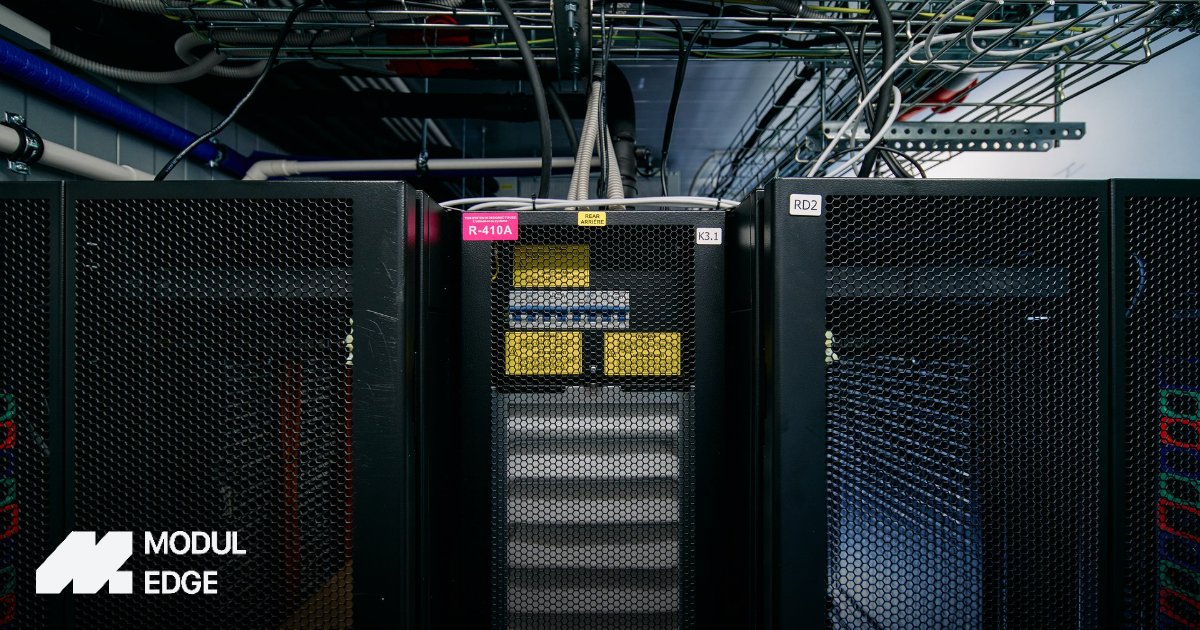
Nvidia Blackwell is the GPU architecture that ended the air-cooled data center. The flagship GB200 NVL72 packs 72 GPUs into a single liquid-cooled rack drawing roughly 120 kW nominal (130–132 kW observed at full load), versus the 7.6 kW industry-average rack (Uptime Institute, 2025). It weighs 1.36 metric tons, requires direct-to-chip liquid cooling by design, and renders most enterprise data center halls structurally and electrically unable to host it.
This post covers the Blackwell lineup → the rack-scale infrastructure demands → deployment reality and pricing in 2026 → the honest Blackwell-vs-Hopper comparison → what it all means for the building you'd put it in. For the Blackwell Ultra generation specifically, GB300 NVL72 gets its own breakdown, including why its sparse NVFP4 figure is identical to GB200's.
The Blackwell lineup, decoded
Blackwell is one architecture sold in escalating power envelopes. Knowing which tier you're buying determines everything about the facility.
B100 (700 W) was the transition part, designed to slot into existing air-cooled HGX H100 chassis. It barely shipped; Nvidia reprioritized toward B200 and rack-scale systems (SemiAnalysis, 2024). B200 (1,000 W air / 1,200 W liquid) is the volume GPU: 180 GB of HBM3e, ~8 TB/s of memory bandwidth, 208 billion transistors across a dual-die package, sold as 8-GPU HGX boards. GB200 pairs one Grace CPU with two Blackwell GPUs on a single ~2.7 kW module. Note that the CPU comes with it, so this is an integrated Arm platform, not a GPU you bolt onto your x86 fleet.
Then the headline act. GB200 NVL72 puts 36 Grace CPUs and 72 Blackwell GPUs in one rack, lashed together by NVLink 5 at 130 TB/s of aggregate bandwidth, so all 72 GPUs behave as one giant accelerator with 13.4 TB of pooled HBM3e. And the 2025 mid-cycle refresh, B300/GB300 "Blackwell Ultra," pushes memory to 288 GB per GPU at 1,400 W, with GB300 NVL72 racks landing around 135–142 kW.
One arithmetic warning before any spec-sheet comparison: Nvidia's biggest numbers are FP4 sparse. Dense figures are half. Hopper had no FP4 at all. Keep that in your pocket for the benchmark section.
What NVL72 demands from a facility
Here's where Blackwell stops being a chip story and becomes a building story.
Power. ~120 kW nominal per rack, 130–132 kW observed; HPE's QuickSpecs split it as 115 kW on liquid plus 17 kW on air. Power arrives through a DC busbar from rack-integrated power shelves, not discrete server PSUs, which means roughly 130 kW of distribution per rack position on 415 V three-phase feeds. Most enterprise PDU plants were never sized for currents like that. Not "need an upgrade" undersized. Categorically undersized.
Cooling. Nvidia ships NVL72 only as a liquid-cooled rack: direct-to-chip cold plates on GPUs, CPUs, and the NVLink switches. Supplier guidance puts coolant flow around 2 litres per second per rack at ~25°C inlet. A typical sidecar CDU handles 60–80 kW of heat; an NVL72 produces 130. So you need in-row or facility-scale CDUs and a facility water loop (SemiAnalysis, 2024). If your hall has no water, your hall has no Blackwell. Our liquid cooling guide covers the full direct-to-chip stack.
Weight. 1.36 metric tons (3,000 lb) in a 600 mm-wide, 48U footprint, per Supermicro's NVL72 datasheet (2024). That's over 2,000 kg/m² of point load against raised floors typically rated for 1,200–1,500 kg/m². Slab-on-grade or reinforced pathways are the norm, which is one more reason purpose-built beats retrofit.
Networking. NVLink copper handles scale-up inside the rack. Between racks you're into Quantum-X800 InfiniBand at 800 Gb/s or Spectrum-X800 Ethernet, which means a dense fiber plant and serious spine capacity arriving alongside the power and cooling upgrade, not after it.
Deployment reality, 2025–2026
The ramp was bumpy, and that's instructive. Early GB200 racks hit overheating problems, coolant quick-disconnect leaks, and NVLink glitches; several hyperscalers trimmed early rack orders before suppliers resolved the issues and shipments ramped from late Q1 2025 (Tom's Hardware, 2025; SemiAnalysis, 2024). Read those failures carefully: they were integration failures, water and power and packaging meeting for the first time in the field. We'll come back to that.
CoreWeave brought GB200 NVL72 online for customers first, in February 2025. Microsoft Azure stood up the first large-scale GB300 NVL72 cluster for OpenAI in October 2025. By early 2026, Blackwell rack-scale capacity is generally available across the major neoclouds and hyperscale clouds. The economics of who rents it and why are covered in how the neocloud business works.
Pricing, for orientation: an NVL72 rack runs roughly $3.0–3.4M, about $3.9M all-in with networking and storage (Tae Kim; SemiAnalysis, 2025). Renting instead: B200s go for ~$3–5.50 per GPU-hour on-demand, and GB200 NVL72 capacity from ~$10.50, averaging ~$18 (Silicon Data, March 2026).
Blackwell vs Hopper: the honest comparison
Sources: Nvidia spec pages (2023–2026); Lenovo HGX B200 product guide (2024); HPE QuickSpecs (2025).
Now, the famous claim. Nvidia's GTC 2024 launch release says GB200 NVL72 delivers "up to a 30x performance increase" for LLM inference versus the same number of H100s, "and reduces cost and energy consumption by up to 25x". The footnotes matter: that's a 1.8-trillion-parameter MoE benchmark at fixed latency, with GB200 running FP4 against H100 running FP8 (H100 can't do FP4), comparing a single NVLink domain against H100s scattered over InfiniBand, and labeled "projected performance subject to change."
Per GPU, like-for-like precision, the generational gain is closer to 2–2.5x. Still big. Not 25x. SemiAnalysis's independent H100 vs GB200 NVL72 training benchmarks (2025) are the best third-party reality check: large but workload-dependent gains, with early-rack reliability as a real operational caveat. Whether Hopper remains the smarter buy for your workload in 2026 is exactly the question we work through in Nvidia Hopper explained.
The number that matters most for infrastructure people isn't on the spec sheet at all: ~40 kW per dense Hopper rack became 120–132 kW per Blackwell rack. A 3–4x density jump in one generation. And the Rubin generation does it again.
Why most existing data centers can't host it
Uptime Institute data cited through 2025 says 68% of enterprise data centers built before 2015 lack the power density and cooling for modern AI workloads, while 82% of them carry 10+ years of remaining lease. Halls designed for 5–15 kW per rack do not absorb 120 kW liquid-cooled racks. They fail three ways at once: no 130 kW feeds per rack position, no facility water loop or CDU plant, and no floor rated for 1.4-tonne cabinets.
The retrofit math is unforgiving. Liquid-cooling retrofits run roughly $50–100K per rack and get you to about 40–70 kW; rear-door heat exchangers top out explicitly below NVL72 territory (Schneider Electric, 2025). Purpose-built 100 kW+ infrastructure runs $200–300K per rack position, and the retrofit route still slams into busbar capacity, water routing through occupied halls, and structural ceilings money can't move.
Which brings us back to those ramp failures. Coolant leaks at quick-disconnects. Undersized CDUs. Power delivery surprises. Every one of them happened where water, power, and structure were integrated in the field, for the first time. The alternative is to integrate them in a factory: a prefabricated module that delivers the 120–140 kW rack envelope, the facility water loop, the leak detection, and the floor rating as a single validated, pressure-tested unit. That's the core argument of the modular data center model, and for Blackwell-class density it stops being a preference and starts being risk management. The broader build sequence (power, cooling, network, structure) is in our AI data center build guide.
Do you even need NVL72?
Honest question, because the answer is often no.
The 72-GPU NVLink domain earns its cost on trillion-parameter MoE inference and frontier-scale training; Nvidia positions GB300 NVL72 specifically for reasoning-model "test-time scaling." For everything below that, air-cooled HGX B200 systems exist: 8 GPUs capped at 1,000 W, roughly four systems per rack at ~60 kW. That's Blackwell-class inference and fine-tuning in a far more hostable envelope, and a strong fit for high-density modular deployments. For edge inference specifically, we've already argued that Blackwell rack-scale is usually overkill at the edge, and choosing the right accelerator class in the first place is its own decision, covered in our GPU vs LPU vs NPU guide.
The buying logic compresses to this: match the NVLink domain to the model size, match the rack envelope to the facility you can actually deliver, and be suspicious of anyone quoting you FP4 sparse numbers against FP8 hardware.
Blackwell didn't just raise the performance bar. It moved the bottleneck out of the silicon and into the building. The operators winning in 2026 are the ones who understood that first.
FAQ
What is Nvidia Blackwell?
Nvidia Blackwell is the GPU architecture announced at GTC 2024, succeeding Hopper. The lineup spans the B200 GPU (1,000–1,200 W, 180 GB HBM3e), the GB200 superchip (one Grace CPU plus two Blackwell GPUs), the rack-scale GB200 NVL72 (72 GPUs, ~120 kW per rack), and the 2025 Blackwell Ultra refresh (B300/GB300, 288 GB HBM3e).
How much power does a GB200 NVL72 rack use?
Roughly 120 kW nominal, with 130–132 kW observed at full load: about 115 kW removed by direct-to-chip liquid cooling and 17 kW by air (HPE, 2025). That's 16–17 times the 7.6 kW industry-average rack reported by the Uptime Institute in 2025.
Does Nvidia Blackwell require liquid cooling?
The GB200 NVL72 ships only as a liquid-cooled rack: direct-to-chip cold plates on GPUs, CPUs, and NVLink switches, fed by CDUs and a facility water loop at roughly 2 L/s per rack. Air-cooled Blackwell exists in HGX B200 form, with GPUs capped at 1,000 W and rack densities around 60 kW.
How much does a GB200 NVL72 cost?
Approximately $3.0–3.4 million per rack, or about $3.9 million all-in with networking and storage (Tae Kim; SemiAnalysis, 2025). Rental alternatives in 2026 run roughly $10.50–18 per GPU-hour for GB200 capacity and $3–5.50 per GPU-hour for B200s.
How much faster is Blackwell than Hopper?
Per GPU at like-for-like precision, roughly 2–2.5x. Nvidia's "up to 25x lower cost and energy" claim applies to a specific rack-scale scenario: a 1.8T-parameter MoE inference benchmark at fixed latency, with GB200 running FP4 against H100s running FP8 over InfiniBand, on projected performance.
Can existing data centers host Nvidia Blackwell?
Mostly not at NVL72 scale. 68% of pre-2015 enterprise data centers lack the required power density and cooling (Uptime Institute, cited 2025). Hosting NVL72 requires ~130 kW per rack position, a facility water loop with CDU capacity, and floors bearing 1.36-tonne racks; typically that means a purpose-built or factory-built modular facility.
What comes after Blackwell?
Vera Rubin. The VR200 platform entered production for H2 2026 volume, with rack power rising to roughly 190–230 kW, followed by Rubin Ultra in the ~600 kW "Kyber" rack in H2 2027. Each generation raises facility requirements again, on an annual cadence.
