March 2, 2026
Modular vs Prefabricated vs Containerized Data Centers: Procurement Guide
Three terms that flood procurement documents. Three concepts most project teams use interchangeably. One result: mismatched bids, scope disputes, and deployments that miss the brief. This guide is for MEP architects, infrastructure agency leads, and systems integrators writing technical specifications.
The Problem with How These Terms Are Used
The terms modular, prefabricated, and containerized have become interchangeable shorthand in procurement documents. They are not the same thing. Each describes a different dimension of how a data center is designed, manufactured, or packaged. Using them as synonyms produces RFPs that attract mismatched bids, create hidden scope gaps, and generate disputes that could have been avoided at the specification stage.
Schneider Electric's White Paper 165 is direct on this point: overlapping and ambiguous labels produce what it calls 'dysfunctional discussions.' The Uptime Institute's provisioning research confirms the downstream consequence: projects miss schedule and budget targets not because the technology fails, but because scope was never clearly defined.
The RFP fix, in one sentence: require every bidder to declare (a) which functional blocks they are delivering, (b) the form factor, (c) the configuration, and (d) a complete FAT/SAT/IST plan. Without these four fields, bids describe different products and cannot be compared.
Three Different Dimensions, Not Three Synonyms
Each term describes a different aspect of how a data center is designed, built, or packaged. You can have a prefabricated containerized modular data center. You can also have a modular design that is neither prefabricated nor containerized. Understanding what each word addresses is the starting point for any coherent RFP.
What Each Approach Actually Delivers (and Constrains)
Modular Architecture: The Scalability Contract
Modularity's core value is incremental deployment. The Uptime Institute's best-in-class provisioning data describes top-tier builders repeating standard power increments (typically 1.5 to 10 MW) to reach total campus capacity. This pattern accelerates parallel work, defers capital expenditure until utilization is proven, and limits disruption when adding capacity.
The constraint is interface discipline. Late customisation destroys the schedule benefit of modular design. If design freeze happens late, you lose the parallelism (factory build running while site pads are poured) that makes the approach competitive. Projects that treat modularity as a procurement label rather than a design commitment routinely fail to realize the benefit.
Prefabricated Data Centers: The Risk Transfer
Factory build shifts risk from on-site labor variability to supply chain and factory throughput. Uptime's research frames this clearly: speed targets increase exposure to supply chain disturbance, and that exposure can cause CAPEX overruns when the chain fails. Prefabrication does not eliminate risk. It relocates it.
The practical timeline benefit is real. Uptime reports 6 months best-case and 8 to 10 months global average for 5 to 19.9 MW facilities using best practices including prefabricated components. A well-documented healthcare deployment in Canada achieved roughly 50% faster delivery than a traditional build by running module fabrication in parallel with on-site concrete pad preparation. The parallel workstream is where the time advantage lives. An RFP that does not plan for and assign responsibility for parallel workstreams will not capture it.
For smaller edge deployments, a custom prefabricated modular data center typically delivers in 3 to 6 months, assuming design is frozen, site is ready, and integration testing is planned before fabrication begins, not after delivery.
Containerized Data Centers: The Logistics Equation
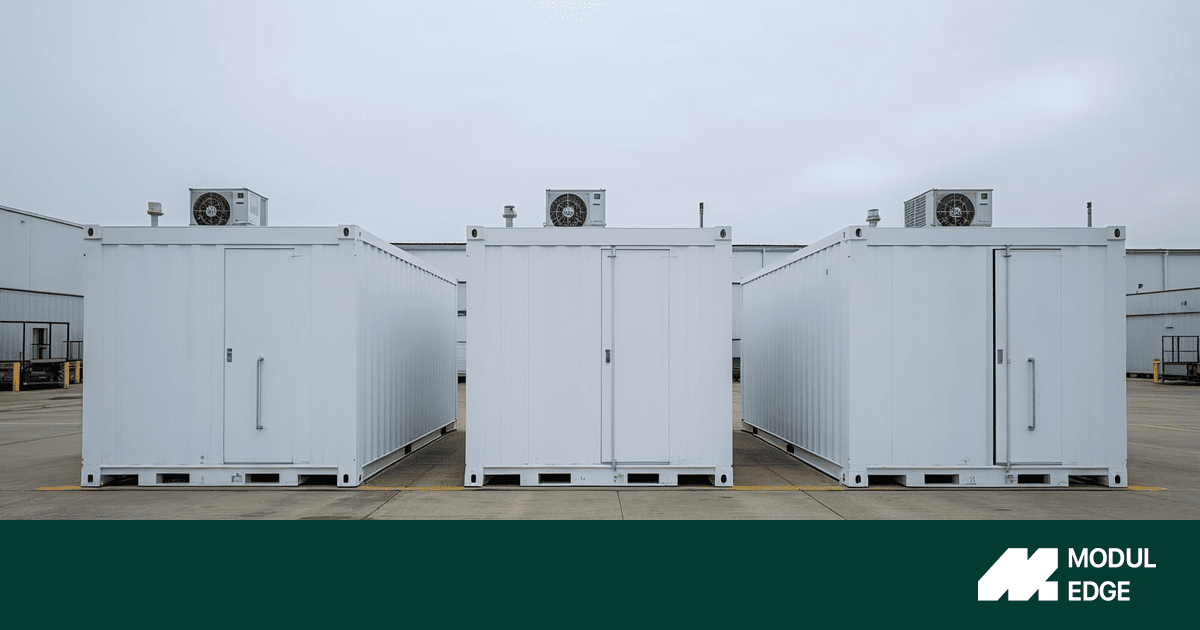
ISO-container form factors simplify intermodal transport and reduce site handling time. A large-scale deployment in Qatar illustrates the argument: 100 fully equipped prefabricated modules delivered 4.9 MW of compute capacity within 14 months, against a comparable regional build that took three years using conventional construction methods.
The constraints are real and frequently underestimated. The ISO footprint caps IT capacity at roughly 200 to 250 kW per container. Low rack-density deployments become expensive per unit because you need more containers to reach the same capacity. Road transport limits, crane access, site security requirements for outdoor placement, and post-modification certification status all add procurement complexity that RFPs often ignore until delivery.
Comparison Table: Definitions, Procurement Language, and Typical Use Cases
The table below is designed for direct use in specification documents or procurement briefs. Copy the 'RFP language to require' row verbatim into your bid requirements.
The Four RFP Pitfalls That Cost Projects the Most
Pitfall 1: Tier-by-Marketing
An RFP that demands 'Tier III' without specifying redundant distribution paths, maintainability narrative, and evidence artifacts will receive bids claiming Tier III on the basis of marketing language. Uptime Institute defines Tier III as concurrently maintainable with redundant components and redundant distribution paths. TIA-942 uses comparable language for Rated-3. Neither classification is inherent to prefabricated or containerized form. A correctly specified enclosure can meet Tier III principles; a poorly designed one cannot, regardless of what the bid response says.
The fix: require every bidder to map their proposed design to one named classification scheme and submit design evidence artifacts, not a checkbox.
Pitfall 2: Unscoped Commissioning
Delivery and commissioning are not the same event. Level 5 Integrated Systems Testing (IST) validates that power, cooling, monitoring, fire suppression, and security all interact as specified under load. It happens after SAT. If your acceptance criteria omit it, you have no contractual mechanism to reject a system that fails under load.
The fix: define 'ready for service' explicitly as passing SAT plus Level 5 IST with named deliverables.
Pitfall 3: Thermal Handwaving
'ASHRAE compliant' without a class, envelope type, and measurement location is not a specification. ASHRAE TC 9.9 recommends 18 to 27 degrees C dry-bulb at rack inlet for Classes A1 to A4. For outdoor containerized modules in MENA climates, ambient design conditions are a primary variable. A bidder designing for 35 degrees C ambient and one designing for 45 degrees C are not producing comparable systems, even if both write 'ASHRAE compliant.'
The fix: state the ASHRAE class, whether you are using the recommended or allowable envelope, and the measurement location.
Pitfall 4: Hidden Scope Gaps
'Turnkey' is not a defined term. Without an explicit boundary diagram and responsibility matrix, utility stub-ups, fiber entry, fire system connections, and site drainage each become the other party's responsibility. Interface Control Documents (ICDs) close this gap before award, not during construction.
The fix: require the bidder to produce an ICD set defining electrical boundary points, mechanical boundary points, controls interfaces, fire and security interfaces, and network entry requirements.
High-Density Edge: Sequence Matters
For edge AI inference, 5G compute, and industrial automation, rack power density determines the viable form factor, not the other way around. Standard containerized form factors designed at 5 to 15 kW per rack do not support 40 kW or above workloads without supplementary cooling infrastructure. AI inference at density (40 kW per rack and above) requires a thermal architecture decision before form factor selection.
A prefabricated enclosure (non-ISO) designed around a specific cooling architecture (direct expansion, adiabatic, free cooling, or chilled water) can accommodate high-density racks in ways that ISO-container form factors cannot without significant modification. The correct procurement sequence: define the workload and its power density first, then select the form factor that can be thermally engineered to support it.
Containerized deployments remain well-suited for lower-density edge scenarios, redeployable assets, defense forward positions, and remote-geography logistics. They are not the right default answer for every edge project.
The Mandatory Bidder Classification Block
Every RFP that involves modular, prefabricated, or containerized data center infrastructure should require the following as a mandatory, non-responsive-if-absent element of the bid response. Adapted from Schneider Electric's taxonomy:
A) Functional blocks delivered: Power / Cooling / IT Space / Controls & Monitoring / Security & Fire (select all that apply)
B) Form factor: ISO container / Non-ISO enclosure / Skid-mounted / Building module / Hybrid
C) Configuration: All-in-one / Fully prefabricated (separate power, cooling, IT modules) / Semi-prefabricated (mix of prefab and site-built)
D) Resiliency classification: State Uptime Tier, TIA-942 Rated, or ISO/IEC 22237 class. Provide mapping narrative and evidence artifacts. Marketing claims without evidence are non-compliant.
This block forces each bidder to describe their product in the same structural terms. It does not constrain the technical solution. It makes bids comparable.
Sustainability Metrics: Get the Boundaries Right
Requesting 'low PUE' without specifying measurement category and metering boundary produces figures that cannot be compared across bids. ISO/IEC 30134-2 defines PUE with measurement guidance including mixed-use buildings and on-site generation. ISO/IEC 30134-9 defines WUE, 30134-8 defines CUE, and 30134-6 defines ERF.
Require PUE reporting per the current ISO/IEC 30134-2 edition, including measurement category and metering boundary diagram. For EU procurement, WUE, CUE, and ERF reporting capability statements are increasingly expected. For containerized deployments, consider requiring embodied carbon accounting using EN 15978 as the boundary framework.
Summary: Five Requirements for Structured RFPs
Take these into your next procurement:
1. Mandatory bidder classification block covering functional blocks, form factor, and configuration. Non-responsive if absent.
2. Named resiliency classification with design evidence artifacts. No marketing claims without documentation.
3. Commissioning plan that defines 'ready for service' as passing Level 5 IST.
4. Thermal specification naming the ASHRAE class, envelope type, and measurement locations.
5. Interface Control Document requirement that closes scope gaps before award.
These requirements do not constrain the technical solution. They make bids comparable and projects deliverable.
