/
Why One of Central Asia's Largest Banks Chooses Modular Infrastructure Over Colocation and Hyperscalers
February 15, 2026
Why One of Central Asia's Largest Banks Chooses Modular Infrastructure Over Colocation and Hyperscalers
When you need 1.9 MW of liquid-cooled AI infrastructure within national borders, colocation trades away control and hyperscale doesn't exist in your region—modular data centers turn a 2-year construction project into a 3-6 month deployment.
I've spent enough time around enterprise infrastructure decisions to know that most of them are made badly. Not because people are dumb, but because the options get framed wrong from the start.
So when I heard about a major Central Asian bank deploying 1.9 megawatts of AI compute — we're talking Nvidia NVL72 and GB300 systems with liquid cooling — and choosing modular data centers over colocation or hyperscale cloud, I wasn't surprised. I was relieved someone finally did the math correctly.
Let me walk you through why this decision will look obvious in hindsight, and why most infrastructure conversations get it backwards.
The three options (and why two of them don't work)
When a bank needs serious AI infrastructure, three paths typically land on the table:
- Colocation — rent space in someone else's facility, bring your own servers
- Hyperscale cloud — rent everything from AWS/Azure/GCP, pay as you go
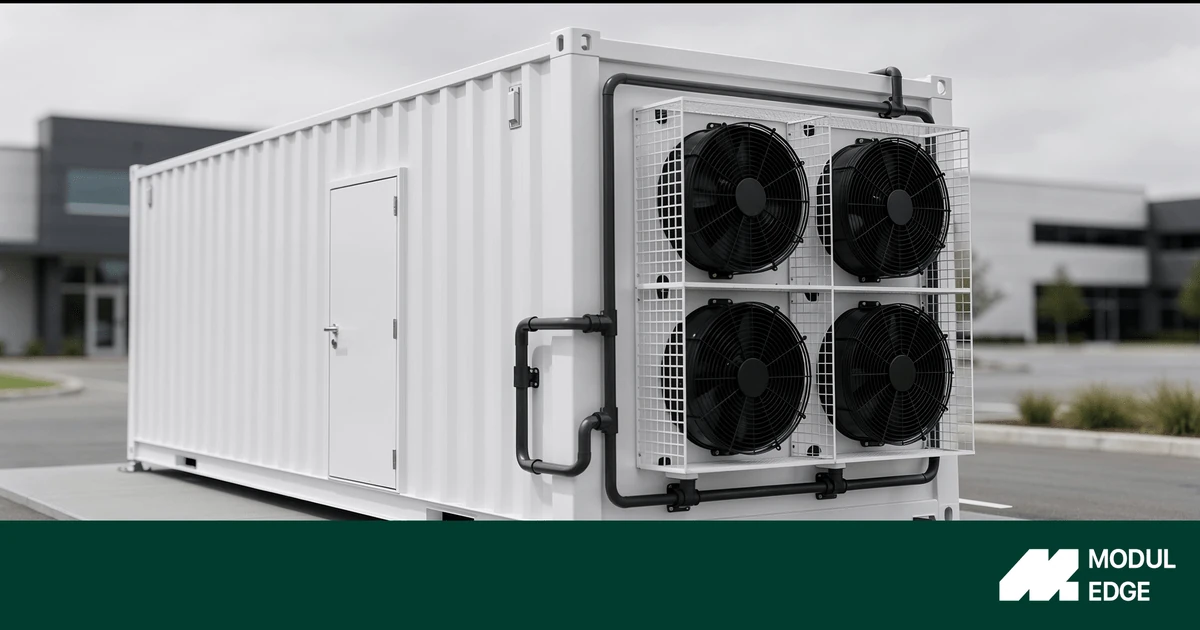
- Modular data centers — buy prefabricated, pre-integrated units, deploy on your own site
Each has a pitch. Each has a reality. Let's go through them.
Option 1: Colocation (the "convenience" trap)
The pitch sounds reasonable: convert CapEx to OpEx, let someone else handle the facility, lease what you need. Simple, right?
Here's what that actually means for a Central Asian bank processing millions of customer transactions:
Your customer data sits in someone else's building. That's not a minor operational detail — that's a strategic vulnerability you're choosing to accept.
Data localization laws across Asia-Pacific are tightening fast. Regulators increasingly require financial data to stay within national borders, with strict conditions on cross-border transfers (Intelligent CIO). When your data lives in a third-party facility, you inherit their compliance posture, their jurisdictional exposure, their security policies. You're paying for convenience and trading away control.
And then there's the cost math, which compounds unfavorably over time. Colocation passes through power costs with margin. For a 1.9 MW deployment running 24/7 over a decade, that margin becomes millions of dollars. Enterprises are figuring this out — for large-scale, constant workloads, owned infrastructure consistently yields lower total cost of ownership (BairesDev).
But the real killer is the density problem. AI racks now draw 40–100+ kW each (Datacentre Solutions). GB300 systems need liquid cooling with precise thermal integration. Colocation facilities have fixed infrastructure — fixed power density limits, fixed cooling architecture, fixed everything. When you need 50+ kW per rack with custom thermal management, "lease more space" isn't an answer. It's a non-sequitur.
Option 2: Hyperscale cloud (the "scale" illusion)
Hyperscalers built their economics around massive, standardized deployments. That model works brilliantly for certain use cases. A regional bank deploying custom AI infrastructure is not one of them.
You're a rounding error to them. A 1.9 MW deployment is nothing to a hyperscaler. You won't get their A-team. You won't get priority support. You won't get infrastructure customized to your thermal and power requirements. You'll get whatever fits their standard offering, and you'll make it work (or you won't).
They're not where you need them. Hyperscale facilities cluster in regions with cheap power and established infrastructure. Central Asia? Not on anyone's expansion roadmap. If a cloud region is far from your user base, latency suffers. And waiting 3–5 years for a regional availability zone isn't a strategy — your competitors are deploying AI capabilities now.
The costs balloon in ways that are hard to predict. Cloud billing is usage-based, which sounds flexible until you realize AI workloads consume massive GPU hours and data egress fees add up fast. Hidden charges appear. Budgets strain (BairesDev). Over a 10-year horizon, owned infrastructure typically runs 60–75% cheaper for steady workloads — and a 1.9 MW AI deployment running inference 24/7 is the definition of steady.
Here's the thing: even hyperscalers know sovereignty is a problem. AWS just launched a European Sovereign Cloud specifically to address EU data residency requirements (Business Wire). But Central Asia? That infrastructure doesn't exist yet. And by the time it does, the banks that waited will be years behind the ones that didn't.
Option 3: Modular data centers (the one that actually works)
Modular data centers do one thing that changes the entire equation: they turn a construction project into a product purchase.
Traditional data center builds take 12–24 months. Modular? 12–16 weeks (Secure IT Environments). That's not incremental improvement — that's a completely different category of timeline.
Here's why the speed difference exists:
Traditional construction is linear. Site prep has to finish before building begins. Then you coordinate separate vendors for UPS, HVAC, fire suppression, security. Then you wait for equipment with 12–18 month lead times. Then you integrate everything on-site. Then you test. Then you fix what broke during testing.
Modular is parallel. Factory assembly and site work happen simultaneously. Modules arrive pre-integrated and pre-tested — power, cooling, security, everything already inside. One delivery. One integration. Done.
For a bank that can't afford construction disruption at an active facility, this matters enormously. Factory-built modules are immune to local weather, skill shortages, and the thousand other things that delay on-site construction.
The sovereignty equation (this is the part most people miss)
Here's what most infrastructure discussions get wrong: they treat sovereignty as a compliance checkbox. It's not. It's a strategic position.
Decisions about where data lives have become decisions about governance (Intelligent CIO). The nationality of your infrastructure provider determines who can access your data, under what legal frameworks, and with what recourse if something goes wrong.
Banks feel this pressure acutely. Regulations like the EU's DORA demand rigorous risk assessments when outsourcing to any ICT third party (Norton Rose Fulbright). Remote access by a non-local engineer can count as an overseas data transfer under some regulatory frameworks. That's not paranoia — that's the actual regulatory reality.
Owned infrastructure simplifies the entire compliance conversation. Data never leaves the country. Audit trails stay under local control. Security policies are set by the bank, not negotiated with a vendor. When regulators ask "where is the data and who can access it?" you have a clean answer.
Why AI infrastructure is different (and why it favors modular)
This isn't generic compute. AI has specific requirements that make the modular advantage even more pronounced.
Thermal management is the real constraint. Nvidia NVL72 and GB300 systems generate serious heat — 50+ kW per rack. Liquid cooling CDUs need precise facility integration. You can't retrofit this into a building that wasn't designed for it.
Factory-built modules arrive with cooling already sized and tested for the actual hardware you're installing (AIRSYS). No compromises. No hoping it works. It's been tested before it shows up.
The obsolescence trap is real. Traditional builds take 2 years. By completion, the GPU generation you designed for may already be outdated. Modular's compressed timeline means infrastructure arrives while hardware is still current — which matters when you're making multi-million dollar compute investments.
Density requirements exceed what traditional facilities can handle. Standard enterprise data centers weren't built for 50+ kW per rack. Retrofitting usually isn't feasible. And even when it is, you're fighting the building instead of working with it. Purpose-built beats retrofit every time.
The TCO reality (yes, the finance people were right)
Banks report faster ROI with modular deployments due to lower upfront costs and optimized operations (Secure IT Environments). Here's why the math works:
Right-sized investment. You deploy what you need now and add modules as demand grows. No stranded capacity. No overbuilding "just in case." No massive upfront bet on predictions that might be wrong.
Predictable economics. CapEx is known upfront. OpEx is modeled before deployment. No surprise rate increases. No renegotiations. No vendor leverage.
The balance sheet treatment matters. Cloud spend is pure expense — it disappears from the books the moment you spend it. Owned infrastructure is a depreciable asset. For a bank, that's not just accounting treatment. That's strategic optionality.
The smart hybrid approach — which more enterprises are adopting — reserves cloud for elastic or spiky workloads and keeps steady, predictable workloads on owned infrastructure (BairesDev). A 1.9 MW AI deployment running inference 24/7 is exactly the workload profile where owned infrastructure wins.
What this signals for the market
This isn't one bank making an unusual choice. This is the emerging playbook for AI infrastructure in markets where hyperscalers haven't arrived and colocation doesn't solve the sovereignty problem.
The banks that move first on owned AI infrastructure gain compounding advantages:
- They iterate faster because they control the compute
- They maintain compliance without architectural compromises
- They build operational expertise while competitors are still negotiating cloud contracts
And here's the thing about compounding advantages: by the time they're obvious, it's too late to catch up.
The bottom line
Colocation trades control for convenience. Hyperscale trades fit for scale. Neither trade works when you need 1.9 MW of AI infrastructure, you need it within national borders, and you need it operational before competitors get there.
The bank understood this. The infrastructure they're deploying will outlast multiple GPU generations. The sovereignty they're preserving can't be retrofitted later. And the competitive advantage started building the day they made the call.
Sometimes the right decision just... is the right decision. This was one of those times.
ModulEdge designs and manufactures modular data centers with rack power from 5–150 kW, multiple cooling options including liquid cooling integration, and optional hardening for demanding environments. Typical custom builds: 3–6 months.
