February 15, 2026
Modular Data Center Design: Power Architecture and Redundancy
Engineering guide: N vs N+1 vs 2N topologies, single-line diagrams, and acceptance criteria for critical infrastructure
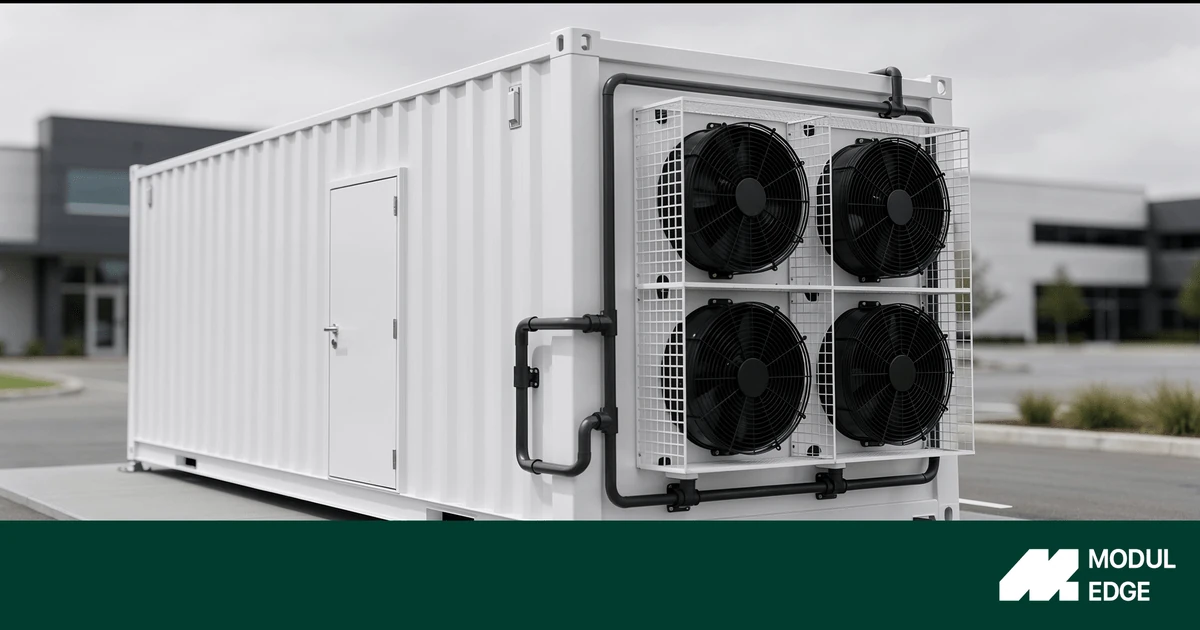
Power architecture is where modular data center design either delivers or dies. Get it wrong, and you inherit all the constraints of traditional construction with none of the benefits. Get it right, and you compress 18-month procurement cycles into weeks while maintaining the resilience your SLAs demand.
This guide cuts through the theory. We cover redundancy topologies (N, N+1, 2N) with reference single-line diagrams, the actual trade-offs in cost, space, and maintainability, and the acceptance criteria your commissioning engineers need to sign off.
The target audience: infrastructure architects specifying modular data center infrastructure into large-scale projects, and enterprise teams building a modular data center room for edge AI or critical operations who need to defend their design decisions to governance committees.
Why Redundancy Topology Matters in Modular Builds
Traditional data center construction separates power engineering from the building. You design electrical systems, procure equipment, coordinate contractors, and hope everything integrates during commissioning. Delays compound. Scope creep multiplies.
Modular data center design inverts this. The power chain - utility feed through UPS through distribution - ships as a factory-tested unit. That changes how you think about redundancy.
In a stick-built facility, adding redundancy means additional construction phases. In a modular system, redundancy is a configuration decision made before manufacturing starts. The implications ripple through every aspect of the project:
- Lead time: Adding a second UPS string in traditional builds adds months. In modular, it adds weeks.
- Space planning: Modular footprints are fixed during design. Upgrading redundancy later may require additional modules, not internal reconfiguration.
- Testing: Factory Acceptance Testing (FAT) validates the complete power chain before shipping. On-site surprises disappear.
Choose your redundancy model at specification time. Changing it later costs both time and money.
The Three Redundancy Models: Definitions
These definitions align with Uptime Institute Tier Standards and TIA-942 data center infrastructure standards.
N - Baseline capacity. The exact number of components required to support the full IT load with no spare capacity. Any single component failure causes downtime.
N+1 - Single redundancy. Adds one spare component (UPS module, generator) to the baseline. A single failure or planned maintenance event can be absorbed without service interruption.
2N - Full redundancy. Two completely independent power paths, each capable of supporting 100% of the IT load. No single point of failure exists. Either path can be taken fully offline without interrupting service.
A fourth configuration - 2N+1 - adds one spare component to each independent path. It is overkill for most applications, drives costs to approximately 3.6x of baseline, and introduces efficiency penalties from running multiple underloaded systems.
Component-Level Architecture
Every modular data center infrastructure design incorporates these core power chain components. Understanding their role clarifies why redundancy decisions cascade through the entire system.
Utility Feed and Transformer
The utility connection provides primary power. A step-down transformer converts medium-voltage (typically 10-35 kV) to low-voltage (400-480 V) for internal distribution. N and N+1 configurations typically use a single utility feed. 2N configurations require dual utility feeds or, at minimum, dual transformers with automatic switchover.
Automatic Transfer Switch (ATS)
The ATS monitors utility power and transfers load to backup generators when mains fail. Transfer time is typically 50-100 milliseconds - fast enough to rely on UPS battery during the gap, but not instantaneous. ATS units must comply with NFPA 110 emergency power requirements.
Backup Generator
Diesel gensets provide extended backup beyond UPS battery runtime. Cold start to stable output takes 5-15 seconds. N+1 configurations deploy spare generator capacity; 2N configurations run independent generator sets on each path. Fuel storage sizing depends on required autonomy - typically 24-72 hours for mission-critical sites.
Uninterruptible Power Supply (UPS)
The UPS bridges the gap between utility failure and generator start. Modern double-conversion units provide clean, conditioned power regardless of input quality. Typical battery runtime ranges from 5-15 minutes - long enough for orderly shutdown or generator takeover. According to Schneider Electric reliability data, Mean Time Between Failures (MTBF) for quality units runs 100,000-300,000 hours per module.
Static Transfer Switch (STS)
In 2N configurations, the STS transfers critical loads between two UPS outputs without interruption. Solid-state thyristors switch within milliseconds. This component enables the 'concurrent maintenance' capability that defines Tier IV-equivalent availability.
Power Distribution Units (PDU)
PDUs distribute power from UPS output to individual racks. In redundant configurations, each rack receives A and B feeds from independent paths. Intelligent PDUs with per-circuit monitoring enable load balancing and predictive maintenance.
Single-Line Diagrams by Redundancy Model
The following reference diagrams show power flow from utility to IT load. These are conceptual single-line representations - actual implementations will include additional protection, metering, and distribution components based on site-specific requirements.
N Configuration (No Redundancy)
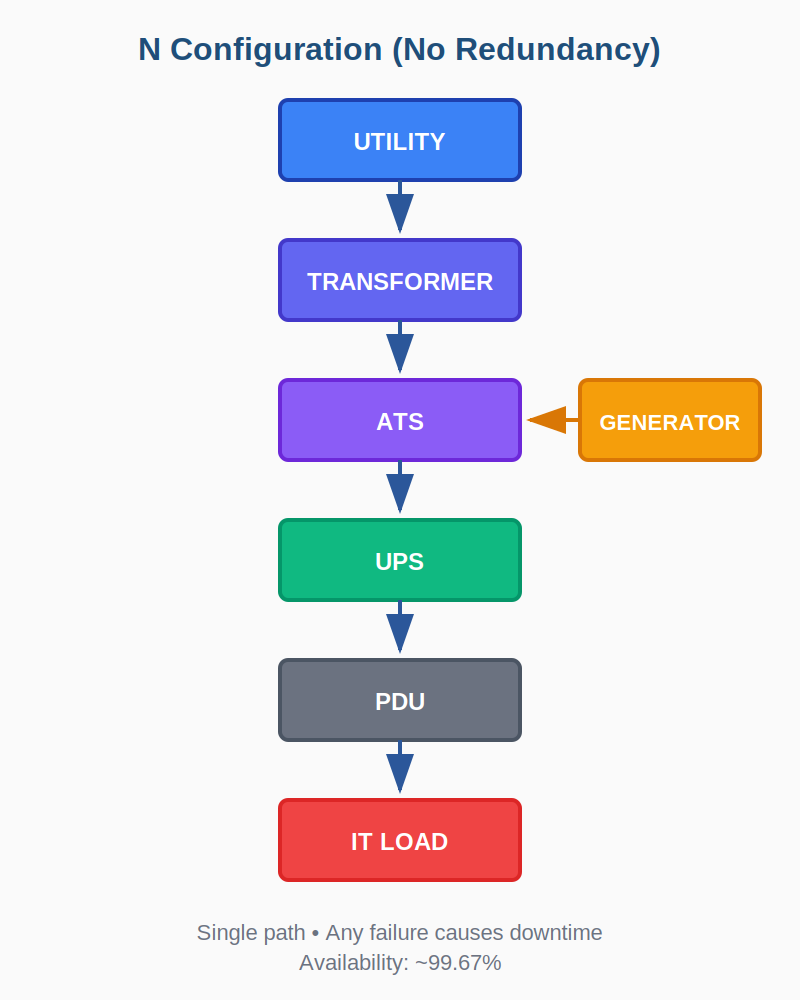
Characteristic: Single path. Any component failure interrupts service. Suitable only for non-critical loads or development environments.
N+1 Configuration (Single Redundancy)
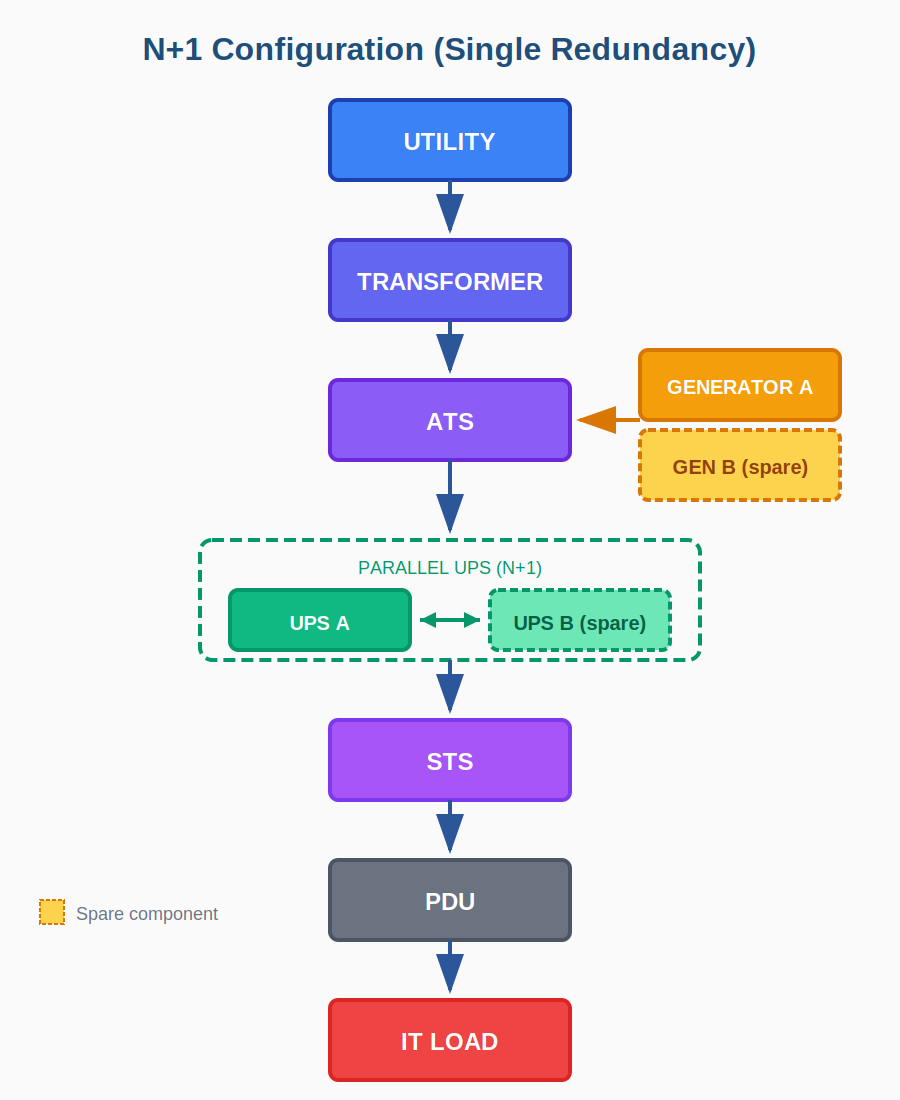
Characteristic: Parallel redundancy at the UPS and generator level. Tolerates any single component failure. Meets Tier III principles when designed with concurrent maintainability.
2N Configuration (Full Redundancy)
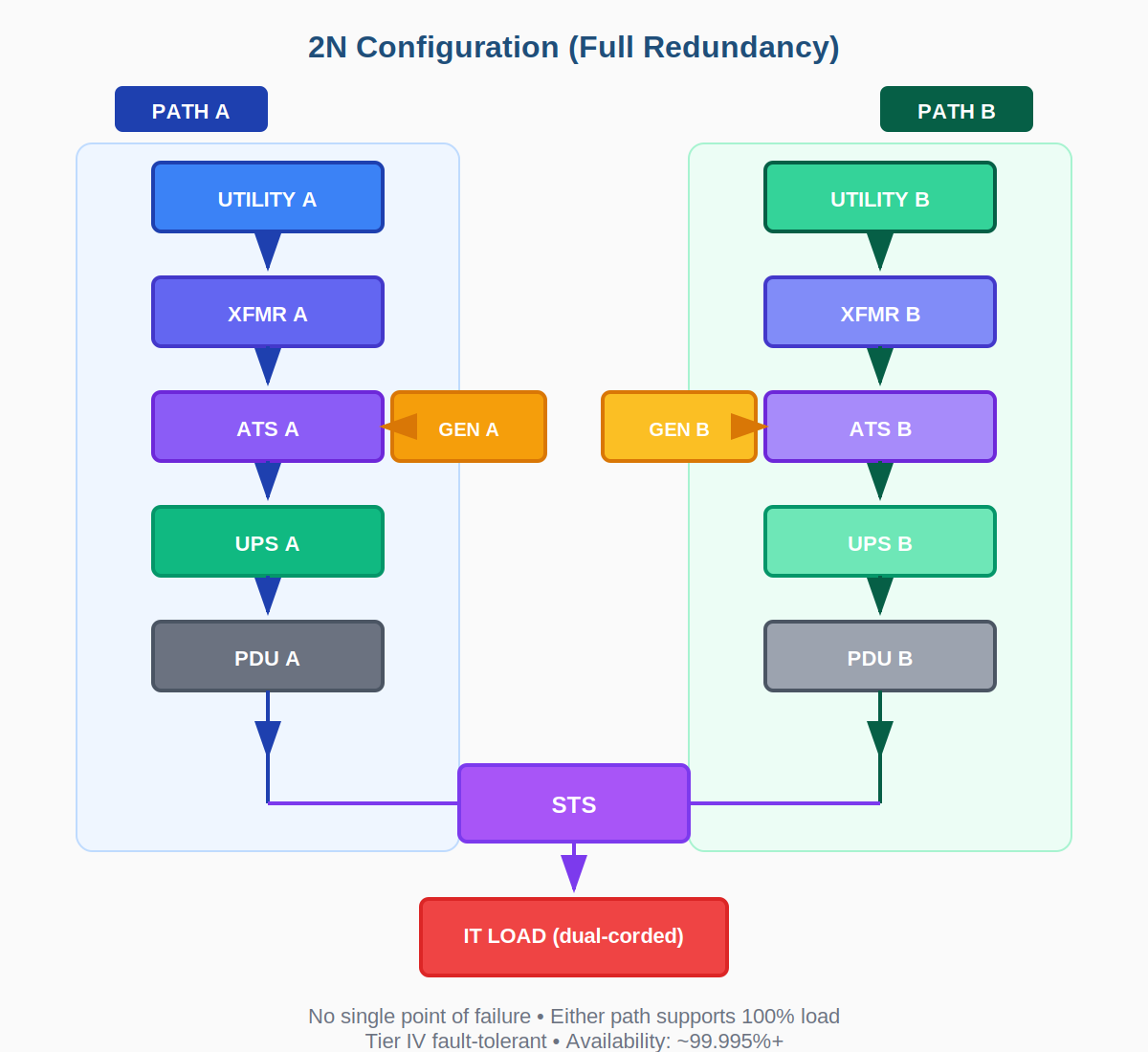
Characteristic: Fully independent paths. Either side can operate at 100% load. Enables concurrent maintenance of an entire power path. Aligns with Tier IV fault-tolerant requirements.
Trade-off Analysis: Cost, Space, and Availability
Here is where the real decisions happen. Every percentage point of availability costs something - in capital, in space, and in operational complexity.
The Real Cost of Downtime
Gartner research on IT downtime costs puts average downtime costs at approximately $5,600 per minute for enterprise operations. At that rate, the annual downtime difference between N+1 (1.6 hours) and 2N (26 minutes) translates to roughly $350,000 in potential loss exposure. Whether that justifies the incremental CapEx depends entirely on your specific workload criticality and revenue impact.
For modular data center room deployments supporting edge AI inference or real-time industrial control, the calculus often favors higher redundancy - not because the availability numbers demand it, but because recovery from an edge site takes longer than recovery from a centralized facility.
Efficiency Considerations
Redundancy comes with an efficiency penalty. Two UPS paths running at 25% load each are less efficient than one path at 50% load. This was the fatal flaw of 2(N+1) designs - they ran at such low utilization that PUE (Power Usage Effectiveness) metrics suffered badly.
Modern 2N implementations mitigate this through active-passive operation: one path carries the full load while the other remains energized but unloaded, available for instant failover. This preserves fault tolerance while improving steady-state efficiency.
For modular deployments, efficiency matters even more. These systems often operate in locations where power costs are high or utility capacity is constrained. The US Department of Energy data center efficiency guidelines provide benchmarks for evaluating PUE targets in constrained environments.
Modular-Specific Design Patterns
Modular data center design introduces constraints and opportunities that do not exist in traditional builds.
Integrated vs. Distributed Power
A modular system can ship with integrated UPS and distribution, or it can connect to site-provided power infrastructure. Integrated systems accelerate deployment but may limit upgrade paths. Distributed configurations offer flexibility but reintroduce on-site coordination complexity.
For most edge and remote deployments, integrated power wins. The factory-tested reliability outweighs theoretical flexibility. For campus deployments where central power infrastructure exists, connecting modules to existing systems may make sense.
Scalable Redundancy
One advantage of modular architecture: you can start with N+1 and scale to 2N later by adding a second module. Each module becomes an independent power path. This staged approach defers CapEx until utilization proves the business case.
The prerequisite: your initial module must be designed for dual-feed operation at the IT load level. Racks need dual PDU connections even if only one path is active initially.
High-Density Considerations
At rack densities above 40 kW - the threshold for edge AI inference workloads - power architecture and cooling become tightly coupled. ASHRAE thermal guidelines for data processing environments address the relationship between power density and cooling requirements. UPS sizing must account not just for IT load but for cooling system power during failure scenarios. Losing utility power means cooling fans, pumps, and compressors also transfer to backup - potentially doubling the transient load on generators.
Addressing Governance Objections
If you are presenting modular data center infrastructure to a corporate governance committee, expect three categories of objection. Here is how to address them.
Safety and Compliance
Objection: 'How do we know these systems meet electrical codes?'
Response: Modular systems are designed and tested to the same standards as traditional builds. UPS equipment complies with IEC 62040 UPS standards and UL 1778; generators meet ISO 8528 reciprocating engine generator sets requirements; switchgear follows IEC 61439 low-voltage switchgear standards. Factory Acceptance Testing provides documented evidence of compliance before shipment. Site Acceptance Testing confirms proper installation.
Budget Justification
Objection: '2N costs twice as much. Why not save money with N+1?'
Response: The CapEx multiple (1.8x for N+1, 2.3x for 2N) applies only to power infrastructure - typically 15-25% of total facility cost. The more relevant comparison is downtime cost versus incremental investment. Additionally, concurrent maintainability in 2N configurations reduces operational expense over the facility lifetime.
Sustainability
Objection: 'More hardware means more energy consumption. How does this align with our sustainability goals?'
Response: Modern UPS systems achieve 96-98% efficiency in double-conversion mode. Active-passive 2N operation minimizes the efficiency penalty of redundancy. More significantly, modular construction reduces embodied carbon compared to traditional builds - less concrete, less on-site waste, shorter construction periods. Energy modeling (PUE analysis) during design validates efficiency targets.
Acceptance Criteria and Commissioning Tests
No modular data center design is complete without defined acceptance criteria. These tests validate that the power architecture performs as designed under both normal and fault conditions. The BICSI 002 data center design standard provides detailed commissioning frameworks.
Integrated System Test (IST)
Beyond component-level testing, the complete power system requires an Integrated System Test simulating worst-case scenarios:
- Utility loss under full load: Verify seamless transition to UPS battery, then to generator.
- Single component failure (N+1/2N): Disable one UPS module and verify load sharing maintains service.
- Full path failure (2N only): Take entire A path offline. Verify B path sustains full load.
- Generator endurance: Run generators for minimum 4 hours under load to validate fuel, cooling, and voltage stability.
Document all test results with timestamps, measured values, and pass/fail criteria. These records become essential for ongoing compliance and maintenance planning.
Monitoring and Operational KPIs
Power system monitoring is not optional. It is what converts a commissioning-day success into sustained operational reliability.
Critical Monitored Parameters
- UPS: Input/output voltage, percent load per phase, battery state-of-charge, internal temperature, bypass status
- ATS/STS: Switch position, transfer count, time since last exercise
- Generator: RPM, oil pressure, coolant temperature, fuel level, run hours
- PDU: Branch circuit current, phase imbalance, ground fault indication
Alarm Thresholds
Configure alerts for conditions that require intervention before they become failures:
- UPS on bypass (immediate notification)
- Battery capacity below 80% rated
- Output voltage deviation exceeding +/-5%
- Generator fuel below 24-hour reserve
- Phase imbalance exceeding 15%
Data logging and trend analysis enable predictive maintenance - catching degrading batteries or increasing UPS temperatures before they trigger outages.
Design Review Checklist
Use this checklist to validate power architecture completeness before finalizing modular data center infrastructure specifications:
Conclusion: Match Architecture to Mission
There is no universal answer to 'which redundancy model is best.' N configurations serve development and non-critical workloads. N+1 delivers the sweet spot for most production edge deployments - meaningful resilience at acceptable cost. 2N is reserved for truly mission-critical applications where any downtime carries unacceptable consequences.
What matters is making the decision deliberately, with full visibility into the trade-offs. Modular data center design gives you that opportunity - the redundancy model becomes a specification choice, not a construction afterthought.
Specify intentionally. Test rigorously. Monitor continuously. The power architecture you choose today determines the availability you deliver for years.
