March 2, 2026
Mobile vs Portable Modular Data Centers: Rooftop, Parking-Lot, and Temporary Capacity Playbook
Choose the right outside-first siting model — mobile data center or portable modular — with a complete playbook: use-case matching, siting checklist, and three site readiness templates.
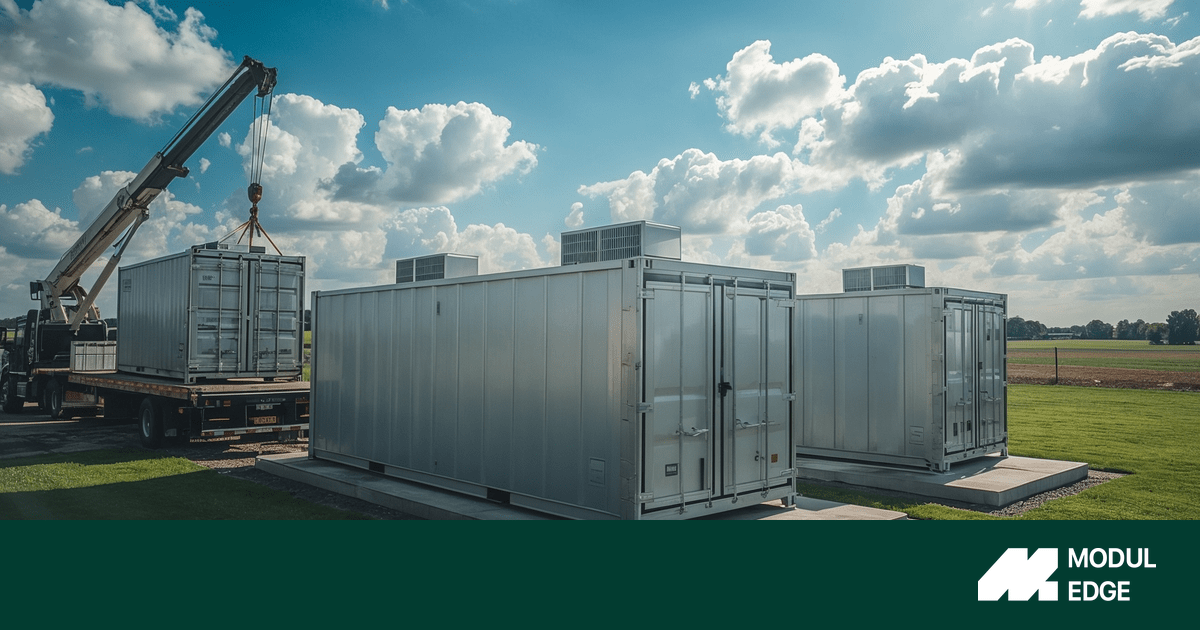
The building ran out of capacity. Or it never had enough. Or the construction timeline is two years and you need compute in four months.
This is the "deploy outside the building" decision — and it shows up more than the industry acknowledges: a hospital running AI inference in a parking-lot module while its data center wing is renovated; a telecom operator dropping an edge module on a rooftop to serve a dense urban district; a mining operation commissioning a compute cluster on a remote site while the permanent control room is being built.
The question isn't whether to deploy outside. It's which solution type, which siting archetype, and what has to be true about the site before the module arrives. Get any of those wrong, and the speed advantage of a factory-built module evaporates in permitting delays, crane complications, and utility rework.
This playbook works through all three. It starts with the mobile vs portable choice, moves to the rooftop, parking-lot, and temporary use-case patterns, and closes with three site readiness templates you can use directly in a procurement package or design brief.
Two Solution Families, One "Outside-First" Thesis
Outside-first deployments treat the building as the point of interconnect — utility service, fiber entrance, operations staff — and place the IT module externally where siting is fastest. Two solution architectures do this in meaningfully different ways.
Mobile Data Centers: The Self-Contained Data Hall
Mobile data centers are transport-rated, weatherized enclosures that integrate racks, power chain, cooling, containment, fire detection/suppression, monitoring, and physical security into a single factory-built unit. The defining characteristic is completeness: the module arrives as a functioning data hall that needs utility connection, not on-site assembly.
Form factors span ISO 20-foot and 40-foot containers, wider non-ISO enclosures (typically 3,000–4,750 mm wide), and trailer-mounted disaster recovery platforms. Typical IT scale is several tens of kilowatts up to several hundred kilowatts per module; multi-module yards scale further. Representative air-cooled configurations run 5–20 kW/rack, with integrated chilled water or advanced liquid cooling designs reaching higher — some HPC-oriented container specs reach 63 kW/rack via two-phase immersion.
Weight matters for siting. A small 4-rack outdoor module with condenser skids runs approximately 8 tonnes. A 300–500 kW, 30-rack modular spec comes in at around 20,350 kg empty and close to 57,350 kg at full IT load. These are structural engineering inputs, not logistics footnotes.
Portable Modular Data Centers: The Edge Room in a Box
Portable modular systems — sealed rack enclosures, micro data center cabinets, small multi-enclosure pods — are a different value proposition. They're compact, relocatable, and optimized for minimal site work. A single-cabinet micro data center might support 3.5 kW of IT load in a 2,000 × 800 × 1,200 mm footprint weighing 263–570 kg. A small pod clusters several such enclosures to create a mini data hall.
The key advantage is operational simplicity: a portable modular unit typically needs a power circuit, a network uplink, and a nearby condenser placement. That's it. Skilled site work is measured in hours, not weeks. Some pod-style solutions position site cycle time — once utilities are ready — in days.
The tradeoff is density ceiling and self-sufficiency. Most portable modular systems run single-digit kW per rack and rely on simpler DX cooling that handles standard compute well but has limits for high-density or GPU-heavy workloads.
Choosing Between Them
The choice comes down to three variables: IT scale, site structural constraints, and how much self-sufficiency the module needs to provide.
For edge AI inference at ≥40 kW/rack — GPU-heavy workloads at industrial sites, remote energy operations, or dense edge compute — the portable cabinet format runs out of thermal headroom. That workload needs a mobile module with a cooling topology matched to the density: integrated chilled water, adiabatic, or liquid cooling, with a site heat rejection strategy planned from the start.
Use-Case Playbook: Three Siting Archetypes
Outside-first deployments fail when siting constraints are treated as afterthoughts. The three archetypes below each have a different set of first-order constraints. Understand which pattern you're in before you configure the module.
Archetype 1: Rooftop Deployment
Rooftop siting is a real-estate arbitrage: you trade yard space and property-line setbacks for structural engineering, wind uplift, crane complexity, and noise propagation to the floors below.
It works when the interior build is harder or slower than the structural upgrade. A rooftop reinforcement and crane day can be cheaper than 18 months of white-space construction — especially when the white space doesn't exist.
Best-fit patterns:
Bridge capacity during interior renovation. The data center wing is offline or being expanded. A rooftop module (or several) maintains service continuity for 6–18 months, then is relocated or sold. This is the economics case: prefabricated module approaches reduce on-site labor and avoid the "space cost" of displacing live operations.
High-security "roof vault." An industrial or multi-tenant building where interior access control is complex and expensive. A sealed, IP-rated rack enclosure on a reinforced roof segment — inside a locked housing with camera coverage — is often simpler to secure than a shared interior room.
Incremental capacity without interior disruption. A few months of factory build time and a crane day add compute capacity without any interior construction, noise, or business disruption during deployment.
What drives the rooftop selection decision:
Choose portable modular when the roof load budget is tight (it often is — unreinforced roofs in commercial buildings typically support 1–2 kN/m², while a mobile container needs careful load distribution engineering), crane reach is constrained, or the requirement is a few racks. The weight differential between a 300 kg sealed cabinet and a 20-tonne container module is the primary structural variable.
Choose a mobile data center module when you need a self-contained, weatherized data hall on the roof — integrated fire suppression, full containment, and a redundant cooling stack. The structural engineering is harder, but the operational outcome is a complete data center, not just a rack with environmental protection.
The three rooftop questions that determine feasibility before anything else:
- Can the roof framing support the module dead load, live load, and wind uplift? (Requires a structural engineer letter — not a vendor estimate.)
- Where does the crane set, and can it reach the placement zone without overhead conflicts?
- Where do condensers go, and does their heat exhaust recirculate into their own intakes?
If you can't answer all three, the rooftop siting is not feasible yet. Everything else in the design follows from these.
Archetype 2: Parking-Lot / Yard Deployment
The parking-lot deployment is the most common outside-first pattern because the siting constraints are the most manageable: ground-bearing capacity handles module weight, delivery truck access is straightforward, and there's room for condensers, generators, and service vehicles.
The tradeoffs are visibility, setbacks, stormwater, and neighbor noise — none of which are technical problems, but all of which can kill a permit.
Best-fit patterns:
Overflow capacity for an existing facility. The data center is full. You can't build internally for 18+ months. An outdoor module tied to existing utility service and carrier fiber is the path to capacity in 3–6 months (from factory-to-FAT for a custom ModulEdge build; some site infrastructure prep runs in parallel). The gating factor is almost never the module — it's whether the utility transformer has headroom and whether the fiber pathway to the module is planned.
Disaster recovery and mobile response. Trailer or container platforms with quick-connect utilities and transport readiness are built for unpredictable siting. The deployment time is measured in days once the site is prepped, not months.
Edge yard for industrial or OT environments. A sealed micro DC or small pod inside a fenced compound, positioned near the OT network boundary, gives control systems local compute without running long fiber into a building that may not have the right access controls or environment for IT equipment.
What drives the parking-lot selection decision:
Choose a mobile data center module when you need a full data hall with integrated cooling/power and you can allocate the pad, setbacks, and condenser footprint. The effective footprint of a container module is larger than its external dimensions once condenser skids, service clearances, electrical gear, and airflow separation are accounted for.
Choose portable modular when you need minimal civil works, minimal visual impact, and a small rack count. A sealed cabinet inside a fenced compound with a utility condenser on the fence line is a week of site work, not a construction project.
The condenser placement problem in parking-lot deployments:
Hot exhaust recirculating into cold-air intakes is the most common performance failure in outdoor deployments, and it's almost entirely a planning failure. The condenser skids that come with DX-cooled mobile modules need separation from the module's fresh air side. On a flat parking lot with multiple modules, this requires a deliberate layout — the rule is: never assume airflow separation just because there's open space. Model it, or pay for it in cooling performance during summer peaks.
Archetype 3: Temporary / Short-Duration Capacity
Temporary deployments optimize for a different set of constraints: time-limited permits, temporary power, fast commissioning, and clear site restoration obligations. The speed advantage of modular compute is most pronounced here — some pod-style solutions position the site cycle time in days once utility prerequisites are met.
Best-fit patterns:
Event compute and media operations (days to weeks). Broadcast, sports venues, large conferences. Portable pod systems minimize logistics: deliver, connect, commission, operate, disconnect, restore. The restoration obligation matters — a temporary deployment that leaves regrading, electrical works, or structural modifications has failed at the planning stage.
Bridge during permanent build. The long-term solution is under construction. The module holds capacity for 6–18 months. Design the temporary deployment with the permanent solution in mind: fiber pathways, utility connection points, and physical security should be consistent between temporary and permanent, not duplicated.
Emergency response and continuity. Unpredictable siting, fast mobilization. Trailer-mounted and container mobile solutions designed around rapid connect/disconnect handle this pattern. The critical procurement question is: does the module have site-independent power (integrated generator) or does it depend on site utility? For true emergency response, generator integration is not optional.
The permit reality for temporary deployments:
"Temporary" doesn't mean "permit-free." It typically means a different permit pathway — one that may move faster but still involves the building official, fire marshal, and often zoning or environmental review if generators or batteries are involved. Plan the permit scope in parallel with the module build, not sequentially after it.
Siting Checklist: The Eight Variables That Determine Whether an Outside-First Deployment Works
This checklist applies across all three archetypes. Every item that is unresolved at the time of site acceptance is a schedule and budget risk.
1. Noise Limits
Get the applicable local environmental noise ordinance before configuration. The condenser fans and compressors in DX-cooled mobile modules are the dominant noise source — not the IT equipment. Published specs for some micro data center variants cite acoustic output below 65 dB, which positions them for building-adjacent deployments; full container modules with external condensers are louder and need acoustic modeling for residential or mixed-use adjacencies.
Capture the ordinance measurement method (dBA, time-of-day, measurement point), require vendor noise figures, and prepare an acoustic mitigation plan if worst-case output approaches the limit. "We'll deal with noise complaints when they happen" is not a mitigation strategy.
2. Footprint (The Real One, Not the Brochure One)
Module external dimensions plus service clearances plus condenser/chiller placement plus electrical gear plus airflow separation equal the real footprint. An ISO 20-foot module has a nominal footprint of roughly 15 m² — but with condenser skids, electrical disconnects, service clearances, and airflow separation, the effective pad area is commonly 30–50% larger.
Draw the layout scaled before committing to the siting. Include door swing, egress path, condenser airflow direction, and the service vehicle access path. Conflicts with roof drains, skylights, or parapets on rooftops — and with utility easements, stormwater drains, or parking aisle widths on the ground — are much cheaper to resolve on a drawing than in the field.
3. Crane Access and Rigging
Every mobile module placed on a rooftop needs a crane. Most mobile modules placed in a parking lot or yard do too, unless they have forklift pockets and the forklift capacity matches the module weight (rare above 5 tonnes).
Require a stamped lift plan for any crane pick. Gather the manufacturer's lifting points, minimum supporting points, and allowable loads before the lift plan is written — not after. The lift plan needs the module's center-of-gravity coordinates and mass from the vendor's engineering submittal.
Verify: crane set location and outrigger bearing capacity (parking lots are typically fine; roof picks from grade have reach constraints), truck/flatbed access to the staging zone, and any overhead obstructions — power lines, canopies, parapets — along the pick path.
4. Structural Capacity (Rooftop)
Treat the module as a structural system with dead load, live load, wind uplift, and lateral loads. Nationally adopted load standards address wind loads for rooftop structures explicitly — the module is not an HVAC unit, and its engineering package should include wind/snow load assumptions that your structural engineer can verify against the local climate exposure.
A structural engineer letter confirming the roof framing can support the module under the applicable load standard is a gate, not a formality. It should specify: permissible uniform and point loads, load distribution method, dunnage/distribution frame requirements, parapet and screen impacts, and penetration/curb design.
Rooftop module weights span a wide range. A sealed portable cabinet might be 300–600 kg spread across a small footprint. A container module is several tonnes distributed across corner points or a structural base frame. These are completely different structural conversations.
5. Utility Readiness
This is the most common reason an outside-first deployment runs behind schedule. The module can be factory-built and FAT-complete, sitting in the fabrication yard, while the site is waiting for a utility transformer upgrade or a new switchgear room.
Confirm: utility transformer/service capacity available or on a confirmed schedule; switchgear and disconnect placement and ratings defined; grounding and bonding design compliant with applicable electrical codes; and for temporary deployments, the temporary power distribution design documented and governed by temporary installation requirements.
If standby generation is part of the deployment, add: generator placement (exhaust, ventilation, fuel storage setback), ATS/STS integration, and applicable emergency/standby power performance standards.
6. Fire Protection
Determine the regulatory classification of the deployment: IT equipment space, containerized structure, or both. These drive different requirements. Fire protection requirements for IT equipment areas and clean agent system design requirements are distinct frameworks — both apply to many modular deployments.
If clean agent suppression is included (it's standard in most mobile data center modules): require a room integrity / door fan test as part of commissioning; confirm the agent type and discharge policy are compatible with local fire authority requirements; and document the suppression inhibit/override mechanism and who controls it.
Battery energy storage above jurisdictional thresholds (lithium-ion in particular) triggers stationary energy storage installation requirements. If the module's UPS uses Li-ion batteries — which most current designs do — confirm the applicable listings and thresholds before siting, not during permitting.
7. Permits: Building, Fire, Zoning, Environmental
Treat the permit set as multi-authority. A typical outside-first deployment touches: the building official (structural modifications, new exterior structures, electrical), the fire marshal (fire protection approach, suppression systems, occupancy classification), planning and zoning (setbacks, screening, visual impact), and potentially environmental/air quality if generators or specific cooling refrigerants are involved.
Triggers that commonly expand the permit set: roof reinforcement or structural modification; new exterior structure with a permanent or semi-permanent footprint; fuel storage above threshold quantities; battery energy storage systems; generator exhaust at property boundaries; and changes to means of egress or access routes.
The permit timeline is typically 4–12 weeks for a standard outside-first deployment, depending on jurisdiction and the completeness of the submittal package. Starting the permit process after module delivery is a schedule failure.
8. Neighbor and Tenant Impacts
These are not soft issues. Condenser noise at 2 a.m., rooftop service access disrupting top-floor tenants, line-of-sight concerns from adjacent properties — any of these can produce a stop-work situation that no amount of technical compliance resolves quickly.
Document: visual screening plan (fencing, parapet extensions, equipment screens), service schedules and after-hours access policy, and the rooftop or yard access pathway relative to tenant-occupied areas. Address these before siting confirmation, not after the lease amendment or permit application surfaces the issue.
Site Readiness Templates
These three templates are designed for use in procurement packages, design briefs, or project kick-off documentation. An item without an acceptance criterion is still open. A site that cannot check every item is not ready for module delivery.
Template 1: Rooftop Site Readiness
Template 2: Parking-Lot / Yard Site Readiness
Template 3: Temporary / Event Deployment Readiness
The Deployment Timeline: What Actually Drives the Schedule
The module build is not the long pole. For a custom ModulEdge module, factory build through FAT typically runs 3–6 months. The long poles are site infrastructure readiness, permitting, and crane logistics.
A realistic outside-first deployment timeline:
Weeks 1–2: Capacity trigger confirmed. IT load, rack count, redundancy intent defined. Siting archetype selected (rooftop / parking lot / temporary). Feasibility screen against the eight checklist variables.
Weeks 2–4: Vendor configuration and preliminary layout. Module form factor, cooling topology, power topology, and monitoring/security scope locked. Preliminary interface schedule produced.
Weeks 4–8: Detailed engineering for electrical feed, cooling hookup, fire protection basis, network pathway, and security integration. Structural review (rooftop) or civil pad design (parking lot) initiated.
Weeks 4–12 (parallel): Permit submissions. Building, fire, zoning, and environmental permits are parallel workstreams, not sequential — and their timelines are jurisdiction-dependent.
Weeks 4–16 (parallel with permits): Module factory build and FAT. Commissioning test plan and interface schedule produced as procurement-grade documents.
Week of delivery: Site prep complete (pad, power landing, fiber, grounding, security perimeter). Crane day (rooftop or heavy lift) or delivery and placement (parking lot). Utility hookups and site acceptance tests.
Commissioning: Functional tests, alarm verification, monitoring integration to owner NMS/DCIM/SOC, cooling steady-state, and failover tests. Go-live authorization against documented pass/fail criteria.
Post go-live: Modular expansion (add modules without disrupting live load) or, at end of lease/program, module relocation or redeployment.
The parallel workflow — module manufacturing concurrent with site prep and permitting — is what makes modular deployment faster than traditional construction. It's not that the module itself builds faster than a data hall; it's that a factory builds it while the site is being prepared, instead of sequentially.
How ModulEdge Fits Into This Playbook
ModulEdge builds custom modular data centers for system integrators and infrastructure engineering teams running outside-first programs. Our modules are designed for EU and MENA markets, including harsh environments: dust, sand, humidity, industrial vibration, coastal corrosion, and sites where "ruggedized" is not a marketing word.
For the parking-lot and rooftop programs: We produce the documentation that makes outside-first deployments work — interface schedules covering power landing, HVAC connections, cable entry, and grounding; commissioning test plans as procurement-grade deliverables; and the Modbus register map, not just the SNMP endpoint list.
For high-density edge AI inference at ≥40 kW/rack: Our catalog supports this workload class with cooling topology matched to the site — DX, chilled water, adiabatic, and free cooling — not applied generically. If the site is in MENA or Central Asia where free cooling contributes significantly to energy economics during cooler months, that conversation happens in the design review, not after FAT.
For temporary and bridge deployments: Modules designed with redeployable footprints: disconnect, move, recommission at the next site. The capital isn't stranded when the program ends.
For partner-first programs: If you're delivering this as a turnkey project to an end customer, we support the OEM/whitelabel model. Your branding, your client relationship, your margin. The module is yours to brand.
The right starting point is the six interface categories from our container data center specification guide, applied to whichever siting archetype you're working with. If you can answer: cooling topology, power topology, form factor (ISO vs wide), monitoring integration targets, and the structural constraints of your site — we can produce an interface schedule and commissioning test plan in a design review.
Standards Reference Map
Structural and wind/seismic loads: ASCE 7 (Minimum Design Loads for Buildings) covers wind and seismic provisions for rooftop structures and equipment; referenced in rooftop attachment guidance and applicable building code pathways (IBC, local equivalents).
Rooftop attachment: FM Global Data Sheet and jurisdiction-adopted building code provisions cover rooftop equipment attachment, wind/tornado, and waterproofing penetration requirements.
Electrical installation and temporary power: NFPA 70 (National Electrical Code) covers grounding, bonding, equipment connection, and temporary installation requirements for electrical systems.
Emergency/standby power: NFPA 110 (Emergency and Standby Power Systems) covers installation, maintenance, and testing for standby generation, relevant to outside-first deployments with integrated or site-provided generators.
Fire protection for IT equipment: NFPA 75 covers fire protection requirements for information technology equipment areas.
Clean agent suppression: NFPA 2001 covers clean agent fire extinguishing systems, including design, installation, and acceptance testing requirements.
Battery energy storage systems: NFPA 855, UL 9540, and UL 9540A cover stationary energy storage system installation and testing; applied when Li-ion UPS batteries exceed jurisdictional thresholds.
Rigging and crane safety: OSHA 1926 Subpart CC (cranes and derricks in construction) and ASME B30 rigging standards apply to lift plan requirements for module placement.
Noise and occupational exposure: Local environmental noise ordinances (municipal/county level); applicable workplace noise exposure regulations for maintenance staff.
Zoning and permitting: International Building Code (IBC) and International Fire Code (IFC) as commonly adopted model codes; permit procedures and fire code scope per authority having jurisdiction.
