March 22, 2026
Green Data Centers: Design, Certification, and Real-World Examples
Green data centers target PUE below 1.4 on 100% renewables. EU EED reporting, EnEfG 1.2 PUE deadline, certifications, and modular efficiency explained.
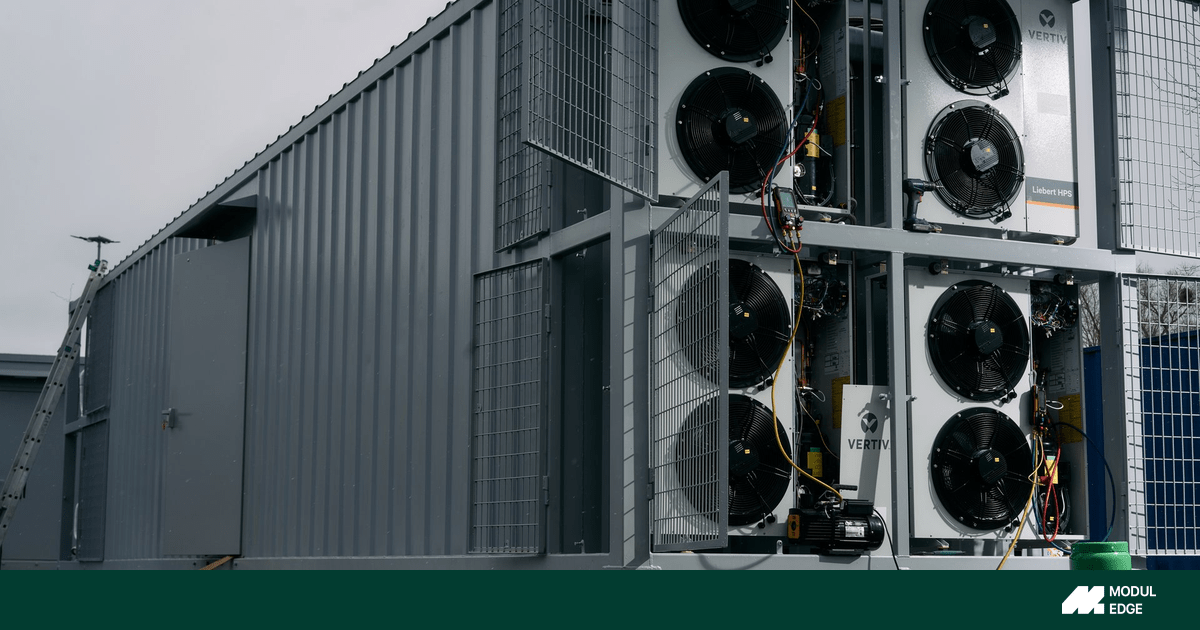
A green data center is a facility designed, built, and operated to minimize environmental impact across six measurable dimensions: energy efficiency (PUE below 1.4), renewable energy sourcing, water conservation, waste heat reuse, low embodied carbon in construction, and circular IT asset management. The global average PUE sits at 1.54 according to Uptime Institute's 2025 survey, while leading hyperscalers operate below 1.1. With data centers consuming 415 TWh globally in 2024 and heading toward 945 TWh by 2030 per the IEA, "green" is no longer a marketing label. It is a compliance requirement, a cost structure, and increasingly a condition for getting permits at all.
This post covers what makes a data center green, the EU regulatory framework tightening around operators, the certification landscape worth paying attention to, real-world examples that set the standard, and why factory-built modular data centers arrive with a structural sustainability advantage.
What Actually Makes a Data Center Green
Let's be specific. The industry has spent years throwing "green" around without agreeing on what it means. That era is ending. The EU's Delegated Regulation 2024/1364 now mandates reporting on 24 separate sustainability indicators for any data center above 500 kW of installed IT power. The Green Grid's DCRE framework (Data Center Resource Effectiveness, launched 2024) integrates PUE, WUE, and CUE into a single maturity model.
A green data center performs well across all six dimensions simultaneously. Optimizing one metric while ignoring others is not green. It is greenwashing with better PR.
Energy efficiency is the most visible metric. PUE (Power Usage Effectiveness) measures total facility energy divided by IT equipment energy. A PUE of 1.0 means every watt goes to compute. The global average has been stuck at 1.54 for six years running. Google reports 1.09. Meta reports 1.08. AWS disclosed 1.15 for the first time in 2024. The gap between average and best-in-class represents billions of dollars in wasted electricity annually.
Renewable energy is increasingly non-negotiable. The IEA's 2025 "Energy and AI" report found that renewables currently supply roughly 27% of data center electricity globally, with coal still powering about 30% (mainly in Asia). Corporate clean energy PPAs hit a record 68 GW globally in 2024, a 29% increase year-over-year, with data centers driving 43% of all deals. Annual renewable matching is table stakes. The frontier has moved to 24/7 carbon-free energy, where every hour of consumption is matched with clean energy on the same grid. Google achieved 66% hourly match in 2024 across operations, with 9 of 20 data center grid regions at 80% or higher.
Water conservation is the sleeper issue. Cooling consumes between 7% of total energy in efficient hyperscale facilities and over 30% in enterprise data centers (per the IEA). Evaporative cooling is cheap and energy-efficient but water-hungry. AWS leads with a WUE of 0.15 L/kWh in 2024, down 40% since 2021. Microsoft announced in December 2024 that all new data centers from August 2024 onward will use zero-water cooling, a closed-loop liquid system saving 125 million liters per datacenter annually. For a deeper look at how AI workloads compound this challenge, see our analysis of how much water AI actually uses.
Waste heat reuse converts a liability into a resource. Data centers reject enormous amounts of low-grade heat. In Nordic countries, that heat now warms homes and swimming pools. Germany's EnEfG mandates an Energy Reuse Factor of 10% for new data centers from July 2026, rising to 20% by July 2028.
Embodied carbon addresses the building itself. A 2024 study in the ASCE Journal of Management in Engineering found modular construction reduced overall construction waste by 78.8% across 59 building projects. Microsoft's hybrid mass timber datacenter achieved 35% lower embodied carbon versus conventional steel.
Circular IT asset management completes the picture: systematic assessment of every server, switch, and storage device for reuse before recycling. The Climate Neutral Data Centre Pact requires 100% server assessment for reuse or recycle by 2030 from all signatories.
EU Regulations That Are Reshaping the Green Data Center Landscape
Here is where it gets real. The EU is not asking nicely. It is building a regulatory architecture that will define what data centers look like in Europe for the next decade.
The EU Energy Efficiency Directive (EED) 2023/1791 requires annual sustainability reporting for every data center with 500 kW or more of installed IT power. The first reports were filed in September 2024. They cover 24 data points: PUE, WUE, Renewable Energy Factor, Energy Reuse Factor, temperature set points, cooling system efficiency, and more. This is a transparency framework, not a performance mandate, at least for now. The Commission plans to release a Data Centre Energy Efficiency Package in April 2026 that will introduce minimum performance standards and a labelling scheme. If you operate above 500 kW in Europe, you are already reporting or you are out of compliance. We break down the full timeline in our EU data center regulations 2026 guide.
Germany's Energy Efficiency Act (EnEfG) went further, faster. It sets binding PUE thresholds: new data centers commissioned from July 2026 must achieve PUE of 1.2 or better. Existing facilities must hit 1.5 by July 2027 and 1.3 by July 2030. The law also mandates 50% renewable energy from January 2024 and 100% from January 2027. Waste heat requirements escalate from 10% ERF in 2026 to 20% by 2028. Fines run up to €100,000. This is not aspirational. This is law.
The Climate Neutral Data Centre Pact represents the industry's self-regulatory response. Over 100 operators and 29 trade associations, covering more than 85% of European data center capacity, committed to five 2030 targets: PUE of 1.3 or better, 100% renewable energy, WUE of 0.4 L/kWh or less in water-stressed areas, full circular economy for IT assets, and exploration of waste heat reuse. In June 2025, the Pact shifted from self-auditing to aligning with mandatory EED reporting as its compliance mechanism.
The EU Corporate Sustainability Reporting Directive (CSRD) was originally set to dramatically expand ESG reporting requirements, but the December 2025 Omnibus Package narrowed its scope to companies with 5,000+ employees and over €1.5 billion in revenue. Still, supply chain obligations mean many data center operators will need to provide sustainability data to customers who do fall under CSRD.
The trend line here is clear. Regulation only moves in one direction.
Green Data Center Certifications That Matter
Not all certifications are created equal. Some cover the building, some cover energy management, some cover the full operational lifecycle. Here is a practical map of what is relevant for a European or MENA operator evaluating a sustainable data center deployment.
For European deployments, EN 50600 is becoming the de facto standard. It is the only framework that covers the full spectrum from site design through operations, and its alignment with ISO/IEC 22237 means a single audit can yield three certifications. The EU Code of Conduct for Data Centres is referenced in the EU Taxonomy, making it strategically valuable for operators seeking green financing.
Green Data Centers in Practice: Real-World Examples
Theory is nice. Deployed infrastructure is better. Here are four facilities that demonstrate what a green data center actually looks like at scale.
Google Hamina, Finland. Built in a converted paper mill on the Gulf of Finland, this facility uses seawater cooling drawn from the Baltic, reusing the mill's original water intake infrastructure. Fleet PUE: 1.09. Energy is 97-98% carbon-free via the Finnish grid and 24 renewable PPAs across Europe. In 2024, Google launched a waste heat recovery partnership with Haminan Energia expected to supply roughly 80% of the city's annual heating demand. Total investment: €3.5 billion to date across seven expansions.
Meta Luleå, Sweden. Located 70 miles south of the Arctic Circle, Meta's first non-US data center runs at PUE 1.07 using 100% outside air cooling with no mechanical chillers. Power comes entirely from hydroelectric generation on the Lule River. The facility earned LEED Gold across buildings, with one structure achieving LEED Platinum. Backup generators were reduced by 70% compared to standard facilities due to the Swedish grid's exceptional reliability.
Equinix PA10, Paris, France. Opened in 2024, this US$163 million facility achieves a design PUE of 1.23 on 100% renewable energy. Its 6.6 MW heat recovery system produces 10,000 MWh of heat per year via partnership with local utility SMIREC, enough for roughly 1,000 homes. During the 2024 Paris Olympics, Equinix waste heat warmed the Aquatic Centre swimming pools. A 430 sqm rooftop greenhouse heated by server waste heat is the first such project in France.
Microsoft/Fortum, Espoo and Kirkkonummi, Finland. The world's largest data center waste heat recovery project. Combined thermal capacity: up to 350 MW, serving approximately 250,000 district heating users and covering 40% of Fortum's regional heating demand. Expected CO₂ reduction: roughly 400,000 tonnes annually. Fortum is investing €225 million (2023-2027). Heat recovery becomes operational during the 2025-2026 heating season. This single project meets an estimated 2-3% of Finland's national emission reduction targets.
Why Modular Data Centers Have a Structural Green Advantage
Here is where the build method becomes a sustainability decision, not just a procurement preference.
Factory-built modular data centers arrive at site with several green characteristics baked in. This is not marketing. It is physics and manufacturing discipline.
Construction waste drops dramatically. A 2024 ASCE study found modular construction reduced overall construction waste by 78.8% versus traditional builds. The Modular Building Institute reports up to 90% waste reduction in factory environments. When you build in a controlled facility rather than an open construction site, you cut material precisely, recycle offcuts immediately, and eliminate weather-related waste entirely.
PUE is optimized in factory, not discovered in the field. Cooling systems, airflow paths, and containment strategies are engineered, assembled, and tested before the module ever leaves the factory floor. A traditional build integrates these systems on-site, where tolerances are wider and variables multiply. Factory-built modular data centers typically achieve PUE in the 1.1-1.3 range at commissioning, comfortably inside Germany's EnEfG threshold of 1.2 for new builds. For a comparison of modular data center cooling options, see our selection guide.
Compact footprint means less land disturbance. A modular deployment requires a concrete pad, utility connections, and crane access. A traditional build requires years of civil works, excavation, and on-site labor across a far larger construction zone. Reduced site disruption is not just convenient. It translates directly to lower environmental impact during construction.
Modular enables right-sizing. Overbuilding is one of the biggest hidden sustainability problems in data centers. Traditional facilities are often sized for peak projected demand that may arrive years late or never materialize, running inefficiently at low utilization. Modular deployments start with one or two modules and add capacity as demand proves itself. Every module runs closer to design load, which means better PUE and less stranded infrastructure.
The JLL 2026 Global Data Center Outlook projects modular data center annual sales reaching $48 billion by 2030, describing the shift as moving from "build-to-suit to assemble-at-scale." With 57% of traditional projects experiencing construction delays of three months or more, and equipment lead times averaging 33 weeks, factory-built approaches offer both speed and sustainability in a single decision.
What to Do with This Information
If you are planning a data center deployment in Europe, MENA, or any market where sustainability regulation is tightening, start with the regulatory checklist. Are you above 500 kW? You are reporting under the EED. Are you building new capacity in Germany? PUE 1.2 is your ceiling from July 2026. Are your enterprise customers subject to CSRD? They will ask for your sustainability data whether you are obligated or not.
Then look at your build method. The gap between a 1.5 PUE traditional build and a 1.2 PUE factory-optimized modular deployment is not a rounding error. Over a 15-year lifecycle, it is millions in energy cost and hundreds of tonnes in avoided emissions.
FAQ
What is a green data center?
A green data center is a facility engineered to minimize environmental impact across energy efficiency, renewable energy usage, water conservation, waste heat reuse, embodied carbon in construction, and circular IT asset management. The EU's 2024 delegated regulation defines 24 specific sustainability indicators that data centers above 500 kW must report annually.
What PUE qualifies a data center as "green"?
No universal threshold exists, but regulatory and industry benchmarks converge around 1.3-1.4. The Climate Neutral Data Centre Pact targets PUE 1.3 or better. Germany's EnEfG mandates PUE 1.2 for new builds from July 2026. The global average is 1.54 (Uptime Institute, 2025), while hyperscalers operate below 1.1.
What certifications exist for green data centers?
The most relevant certifications include EN 50600 (European full-lifecycle standard), ISO 50001 (energy management), ISO 14001 (environmental management), LEED (building sustainability), BREEAM (building sustainability, strongest in Europe), CEEDA (energy efficiency operations), and the EU Code of Conduct for Data Centres.
What EU regulations apply to data center sustainability?
The EU Energy Efficiency Directive (EED) requires annual sustainability reporting for facilities above 500 kW. Germany's EnEfG sets binding PUE, renewable energy, and waste heat reuse thresholds. The EU plans a Data Centre Energy Efficiency Package with minimum performance standards for April 2026.
How do modular data centers support sustainability?
Factory-built modular data centers reduce construction waste by up to 78-90%, achieve PUE of 1.1-1.3 through controlled manufacturing, minimize site disruption, and enable right-sized capacity that avoids the efficiency losses of overbuilt traditional facilities.
What is the Climate Neutral Data Centre Pact?
The CNDCP is a self-regulatory initiative of over 100 European data center operators and 29 trade associations, representing 85%+ of European capacity. Signatories commit to five 2030 targets: PUE 1.3 or better, 100% renewable energy, WUE 0.4 L/kWh or less in water-stressed areas, 100% IT asset assessment for reuse/recycle, and active waste heat reuse exploration.
What is 24/7 carbon-free energy and why does it matter?
Traditional renewable matching purchases enough certificates over a year to equal total consumption, but the facility may run on fossil fuels during specific hours. 24/7 carbon-free energy matches every hour of consumption with clean energy on the same grid. Google achieved 66% hourly match in 2024. Over 100 organizations have joined the UN-backed 24/7 Carbon-Free Energy Compact.
How is data center waste heat being reused in Europe?
Nordic countries lead implementation. Google's Hamina facility will supply 80% of local district heating demand. The Microsoft/Fortum project in Finland will serve 250,000 users. Stockholm Data Parks integrates 20+ data centers into municipal heating, warming approximately 30,000 apartments. Germany's EnEfG mandates escalating waste heat reuse from 10% in 2026 to 20% by 2028.
