/
Edge AI Infrastructure for Inference: Translating AI Servers into Rack Power, Cooling, and Module Design
Edge AI Infrastructure for Inference: Translating AI Servers into Rack Power, Cooling, and Module Design
How to size power, cooling, and physical infrastructure for edge AI workloads – and why 40 kW per rack marks the inflection point.
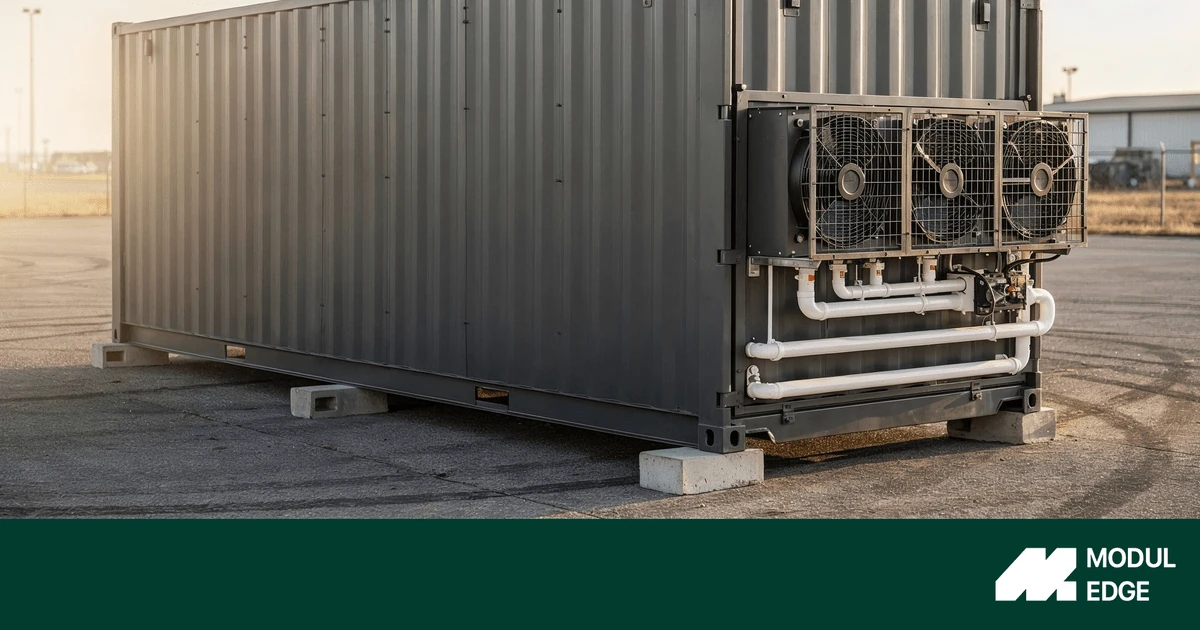
The AI server you just spec'd draws 10 kW. Multiply by four, add networking and storage, and suddenly your rack hits 45 kW. Traditional air conditioning can't cope. Your existing facility's electrical panel wasn't designed for this. And the hyperscale cloud you've been using introduces 40 ms of latency that makes real-time inference useless for your application.
This is the infrastructure gap facing enterprises deploying edge AI inference today. The compute is available – NVIDIA's L40S, A100, and H100 accelerators are shipping. The models work. But the physical infrastructure between "we bought the hardware" and "it's running in production" remains the hardest problem to solve.
This guide translates AI server specifications into the power, cooling, and module design decisions that MEP engineers, infrastructure architects, and enterprise IT leaders need to make. It covers why inference at the edge has fundamentally different infrastructure requirements than training in the cloud, how to calculate rack power density from GPU specifications, what cooling architectures work at different thermal loads, and when modular data centers become the only practical deployment path.
Why Inference at the Edge Has Different Infrastructure Requirements
Before diving into power and cooling calculations, it's worth establishing why edge AI inference creates unique infrastructure challenges that centralized training clusters don't face.
Latency drives location. Training a large language model can tolerate network round-trips measured in hundreds of milliseconds because batch processing dominates. Inference for real-time applications – autonomous vehicles, industrial quality inspection, video analytics, medical imaging – requires single-digit millisecond response times. That latency constraint physically anchors compute to the data source: the factory floor, the cell tower, the hospital, the oilfield.
Scale is distributed, not concentrated. A training cluster might deploy 10,000 GPUs in one facility. Edge inference spreads 10–100 GPUs each across hundreds of sites. The infrastructure problem shifts from "build one massive facility" to "deploy many standardized, hardened modules in locations with limited power and no IT staff."
Environments are hostile. Hyperscale data centers control temperature to ±1°C in purpose-built facilities. Edge locations include desert telecommunications sites at 50°C ambient, vibrating platforms in industrial plants, and dusty construction zones. Infrastructure must tolerate conditions that would shut down a conventional server room.
Power availability varies. Cloud data centers negotiate megawatt utility connections years in advance. Edge sites work with whatever power exists: 100 kW from a factory substation, a diesel generator on an offshore platform, or a 400 kW feed shared with building HVAC. The infrastructure must fit the available power envelope, not demand a new one.
These constraints reshape every infrastructure decision, from rack density to cooling topology to physical form factor.
From GPU Specs to Rack Power: The Math That Drives Everything
Understanding rack power density for AI inference starts with the individual GPU and builds up through server, rack, and module levels.
GPU-Level Power Draw
High-end inference GPUs consume 300–400 W at full load. The NVIDIA A100 (PCIe variant) draws 300 W TDP. The L40S runs at 350 W. The H100 PCIe variant hits 350 W, while the SXM5 variant reaches 700 W with the high-power configuration. These numbers represent continuous power draw under inference workloads – not peak spikes, which can exceed rated TDP by 10–15% during rapid load transitions.
The key insight: inference workloads rarely sustain 100% utilization. Unlike training, which drives GPUs to maximum throughput continuously, inference exhibits bursty patterns. A video analytics system might average 60–70% utilization with peaks during high-motion scenes. This utilization profile affects both average power draw and cooling system sizing – you need capacity for peaks while paying for average.
Server-Level Power Draw
An AI inference server combines multiple GPUs with CPUs, memory, storage, and networking. Real-world configurations:
A 2U server with 4× A100 GPUs draws approximately 1.5–2.0 kW under inference loads. This includes two Xeon CPUs (~300 W combined), 512 GB memory (~50 W), NVMe storage (~20 W), and 100 GbE networking (~50 W) alongside the 1.2 kW from GPUs at average utilization.
A 4U server with 8× L40S GPUs reaches 3.5–4.0 kW. The higher count adds GPU power (2.8 kW at full load) plus additional CPU and memory to feed them.
An 8× H100 system – NVIDIA's DGX H100 or equivalent – draws 10.2 kW at the outlet. This represents the upper bound for air-cooled inference servers and typically requires dedicated circuits and careful rack placement.
Rack-Level Power Density
Stacking servers into racks creates the density numbers that drive all downstream infrastructure decisions.
Traditional CPU-only racks: 5–15 kW. A rack filled with 1U web servers or 2U database servers typically draws 8–12 kW. This is what existing data center infrastructure – building HVAC, electrical panels, floor loading – was designed to support.
GPU inference racks: 20–50 kW. Fill a 42U rack with 4-GPU inference servers (accounting for networking switches and cable management) and you reach 20–30 kW easily. Add 8-GPU systems and density climbs toward 40–50 kW. Analysis from Goldman Sachs showed that a rack of eight-GPU servers draws 20–40 kW compared to a standard 5–15 kW for a CPU rack – a challenging but manageable increase that nonetheless demands infrastructure rethinking.
The 40 kW threshold. Industry consensus marks 40 kW per rack as the inflection point between "enhanced air cooling can handle it" and "you need liquid assist or dedicated cooling infrastructure." This number appears consistently across vendor specifications, deployment case studies, and engineering guidelines because it represents the practical limit of contained hot-aisle/cold-aisle configurations with in-row or overhead air conditioning.
At 40 kW, a rack generates approximately 136,000 BTU/hour of heat. Removing that thermally requires roughly 6,500 CFM of airflow at a 10°C temperature differential – the equivalent of running multiple 5-ton AC units directly at the rack. As detailed thermal analysis demonstrates, the physics simply doesn't work in a small edge footprint without supplemental liquid cooling.
Module-Level Power Budgets
Edge deployments rarely involve single racks. A practical AI inference installation might include 4–12 racks depending on workload scale. Module-level power budgets:
Small edge node (2–4 racks): 50–150 kW. Suitable for single-site video analytics, local LLM inference for customer service, or industrial quality control. Fits in a 20-foot container or outdoor enclosure.
Medium edge deployment (6–10 racks): 150–300 kW. Supports regional inference hubs, telecom MEC (Multi-access Edge Compute) applications, or manufacturing plants with multiple AI systems. Typically requires a 40-foot container or purpose-built module.
High-density edge (10–15 racks at 40+ kW each): 400–600 kW. Approaches what's possible in a single modular unit with advanced cooling. Real deployments have achieved 660 kW in 45-foot containers using rear-door liquid cooling on every rack.
Cooling Architectures for 20–50 kW Racks
Cooling is where edge AI infrastructure design becomes genuinely difficult. The 20–50 kW per rack range that characterizes AI inference falls into a thermal management gap: too hot for conventional air conditioning, not dense enough to justify full immersion cooling, and deployed in environments where external cooling plant may be impossible.
Air Cooling: Viable to ~30 kW, Stressed at 40 kW, Inadequate Beyond
Direct expansion (DX) and chilled-air CRAC/CRAH systems remain the default approach for data center cooling. In contained hot-aisle or cold-aisle configurations, they can handle up to approximately 30 kW per rack with proper design.
The mechanism: cold air (typically 18–22°C) enters through a contained aisle or raised floor, passes through servers, exits as hot air (35–45°C), and returns to cooling units. The cooling units use refrigerant (DX) or chilled water (CRAH) to reject heat to an external condenser or cooling tower.
At 40 kW per rack, air cooling reaches its practical ceiling. The required airflow volume – approaching 8,000 CFM per rack – creates turbulence, hotspots, and distribution problems that no amount of containment can fully solve. Hot-climate deployments make this worse: when ambient temperature reaches 40–50°C (common in MENA summers), DX condensers lose efficiency dramatically and may need oversizing by 30–50%.
When to use pure air cooling: Lower-density inference deployments (20–30 kW/rack average) in temperate climates with adequate space for external condensers. Often the right choice for initial deployments that may grow denser over time – but plan for liquid-assist upgrade paths.
Liquid-Assisted Air Cooling: The Sweet Spot for Dense Edge AI
The practical solution for 40–50 kW racks combines air and liquid: use liquid to extract heat at or near the rack, then reject that heat externally. This approach dramatically reduces the airflow requirements inside the module while providing cooling capacity for dense loads.
Rear-door heat exchangers (RDHx) mount water-cooled coils on the rack exhaust. Hot air (40–45°C) passes through the coils, transferring heat to circulating coolant (water or water-glycol mixture at 30–35°C supply temperature). The coolant flows to an external dry cooler or chiller to reject heat.
Rear-door units can remove 20–40 kW per rack depending on coil size and coolant flow rates. They require no modification to existing servers – any air-cooled equipment works. The trade-off: they add depth to racks (100–200 mm), require coolant distribution piping, and introduce potential leak points.
A real deployment example: an AI data center in Norway houses 12 racks in two 45-foot containers. Each rack runs at 55 kW. Rear-door coolers on every rack, fed by external dry coolers with adiabatic assist, maintain stable temperatures even during Nordic summer. Total capacity: 660 kW from two modules plus cooling plant.
In-row cooling units place chilled-water or refrigerant-based cooling directly between racks, supplementing overhead or underfloor air distribution. They work well for mixed-density environments where some racks run hot (40+ kW) while others stay moderate (10–20 kW). The cooling unit targets hot spots rather than treating the entire room uniformly.
Adiabatic cooling adds evaporative assist to air-cooled systems. Water sprayed onto heat exchanger surfaces evaporates, absorbing heat and dropping the effective rejection temperature below ambient. In dry climates (Gulf states, Central Asia), adiabatic systems can improve DX and dry cooler efficiency by 30–40%, enabling free cooling at night and reducing daytime mechanical cooling loads.
The trade-off: water consumption (1–3 liters per kWh of cooling) and mineral buildup requiring regular maintenance. In water-scarce regions, the operational cost and logistics of water delivery may outweigh efficiency gains.
Direct Liquid Cooling: For 50+ kW and Extreme Environments
When rack density exceeds 50 kW or ambient conditions make air-based rejection impractical, direct liquid-to-chip cooling becomes necessary.
Cold plates mounted directly on GPUs and CPUs circulate coolant (typically water or water-glycol) at the chip surface. Heat transfer at the junction point removes 70–80% of the thermal load before any air is involved. The remaining heat from memory, VRMs, and storage can be handled by minimal airflow.
Cold-plate cooling supports rack densities of 80–150 kW and beyond – well into training-cluster territory. It requires servers with liquid-cooling headers (increasingly common from NVIDIA and OEM server vendors) and coolant distribution units (CDUs) in the module to manage flow, temperature, and pressure.
For edge AI inference, cold-plate cooling is typically overkill – the density doesn't warrant the complexity. But it provides future-proofing for sites that may evolve from inference to fine-tuning or handle increasingly dense GPU generations.
Immersion cooling submerges entire servers in dielectric fluid (mineral oil or engineered fluids like 3M Novec). The fluid absorbs all heat directly, eliminating fans, air filtration, and temperature gradients entirely. Heat is rejected through fluid-to-water heat exchangers to external cooling plant.
Immersion can handle 100–200 kW per tank – effectively unlimited density. It also provides inherent protection against dust, humidity, and contaminants, making it attractive for extreme environments.
The trade-offs are significant: specialized servers (or adapters for standard hardware), higher fluid costs (engineered dielectrics run $50–100/liter), maintenance complexity (component replacement requires extraction and cleaning), and limited vendor options. Immersion remains a specialized solution for edge AI, typically reserved for mining, defense, and environments where air-based cooling is genuinely impossible.
Cooling Choice Decision Framework
Module Design: Form Factor, Electrical Architecture, and Physical Constraints
Cooling drives module design, but electrical architecture, physical form factor, and deployment logistics create additional constraints that shape what's possible.
Form Factor: ISO Containers vs. Purpose-Built Modules
The dominant form factor for edge modular data centers follows ISO container dimensions: 20-foot (6.1 m × 2.4 m × 2.6 m) or 40-foot (12.2 m × 2.4 m × 2.9 m) variants. This standardization enables road, rail, and sea transport without special permits in most jurisdictions.
Single-row layouts place IT racks along one wall with cooling equipment opposite. Typical capacity: 4–8 racks in a 20-foot container, supporting 50–150 kW total IT load. Airflow runs perpendicular to the container length, entering through cooling units and exhausting through hot-aisle containment to return plenums.
Dual-row layouts place two rows of racks with a contained hot aisle between them. This doubles rack count (8–15 in a 40-foot container) while maintaining effective thermal management. Cooling units – either in-row or overhead – serve both rows. Capacity: 150–400+ kW depending on cooling infrastructure.
Multi-module deployments link containers via vestibules or docking modules to create larger facilities. Two 40-foot containers with a connecting corridor provide 20+ rack positions and 500+ kW capacity while maintaining the modularity benefits of factory-built units.
Purpose-built (non-ISO) modules sacrifice transportability for optimized footprint. A custom enclosure can incorporate irregular shapes, integrated cooling plant, and site-specific features. The trade-off: higher manufacturing cost, special transport permits, and reduced redeployability.
Electrical Architecture: From Utility Feed to GPU
High-density edge modules require electrical infrastructure that matches hyperscale data centers but fits a constrained footprint.
Utility connection. Most modules accept three-phase 380–415 VAC (50/60 Hz) at the boundary. A 250 kW module needs approximately 360 A service at 400 V to cover IT load plus cooling overhead (typically 1.3–1.5× IT load). Larger deployments may require medium-voltage (11 kV or 22 kV) step-down transformers on-site. Infrastructure requirements for high-end GPU systems detail the electrical architecture needed to support dense AI configurations.
Power distribution inside the module. Bus ducts or cable trays run from the module boundary to overhead or underfloor distribution. Rack-level PDUs (Power Distribution Units) break feeds into individual server connections, often with A/B redundancy (dual-corded servers connecting to separate PDU feeds).
UPS systems. Uninterruptible power supplies – typically modular Li-ion or VRLA units – provide 5–15 minutes of ride-through for generator start or graceful shutdown. A 250 kW IT load requires approximately 300 kVA UPS capacity with N+1 redundancy. In edge locations without generator backup, extended-runtime battery systems may substitute for mechanical backup power.
Power quality. AI workloads create power quality challenges beyond simple load sizing. GPU clusters exhibit rapid load transients – power draw can change by 30–50% in milliseconds as batches complete and new work starts. Inrush currents during power-on can exceed steady-state draw by 2–3×. The electrical system must handle these transients without tripping breakers or causing voltage sag that affects other equipment.
Modern modular designs incorporate power factor correction (PF >0.95), harmonic filtering, and transient voltage suppression as standard. Monitoring systems track power quality metrics (THD, voltage variance, frequency) to detect problems before they cause outages.
Physical Constraints: Weight, Clearance, and Access
A fully equipped modular data center weighs 10–20+ tons. A documented example: a 50 kW, 2,500-GPU container in Sweden weighed 15 tons. This weight requires:
- Concrete pads or steel platforms rated for distributed loading
- Crane access for placement (modules cannot be moved by forklift)
- Route surveys for road transport (bridge weight limits, turning radii)
External clearance requirements vary by cooling type. Air-cooled modules need 1–2 meters clearance around condenser units for airflow and maintenance access. Liquid-cooled modules with external dry coolers may require 3–5 meters separation from the main enclosure to accommodate cooling plant.
Deployments in confined spaces – rooftops, parking structures, existing industrial facilities – must verify floor loading, overhead clearance for crane lifts, and access paths for initial placement and future equipment service.
Deployment and Compliance: What Changes by Region
Modular construction accelerates deployment compared to traditional builds, but regulatory and logistics requirements vary significantly across EU, MENA, and Central Asian markets.
EU Deployments
CE marking is mandatory. All electrical panels, cooling systems, and structural components must meet relevant EU directives: Low Voltage Directive (2014/35/EU), EMC Directive (2014/30/EU), and potentially Machinery Directive (2006/42/EC) for active cooling equipment.
Building permits vary by country and site classification. An outdoor containerized data center may be treated as temporary equipment, permanent infrastructure, or even a building depending on connection to utilities and duration of deployment. Industry analysis of regulatory challenges emphasizes that engagement with local planning authorities early in the project timeline prevents surprises.
Energy efficiency requirements (EU Energy Efficiency Directive) may impose reporting obligations for facilities above certain power thresholds. PUE (Power Usage Effectiveness) documentation and cooling system efficiency data should be prepared for regulatory review.
Grid connection for loads above 100 kW typically requires utility coordination. Lead times for new service range from weeks (existing infrastructure, simple upgrade) to months (new transformer installation, network reinforcement).
MENA Deployments
High ambient temperatures (45–50°C) require cooling system de-rating or selection of equipment rated for extreme conditions. Standard DX units lose significant capacity above 45°C ambient; specify high-ambient kits or size for peak temperature, not average.
Dust and sand ingress protection is essential. IP55 or IP65 enclosure ratings prevent particle entry. Filtration at air intakes – often multiple stages including sand traps – adds pressure drop that cooling fans must overcome. Factor 10–20% efficiency loss into cooling calculations.
Civil defense approvals (fire systems, structural safety) apply in most Gulf countries. Documentation requirements exceed EU norms; engage local consultants familiar with approval processes.
Water availability for adiabatic cooling varies by location. Coastal facilities may have seawater access for cooling (with appropriate heat exchanger materials), while inland sites may depend on trucked water delivery. Factor water logistics and cost into operational planning.
Central Asia Deployments
Extreme temperature ranges (−30°C winter to +40°C summer) require dual-mode cooling: economizer/free-cooling during cold months, mechanical cooling during summer. High R-value insulation (above standard container specifications) prevents condensation and reduces heating load in winter.
Grid reliability varies significantly. Sites may experience frequent outages, voltage fluctuations, or frequency variations. Specify wide-input-range UPS systems and consider extended battery runtime or on-site generation for critical deployments.
Transport logistics dominate project timelines for landlocked countries. Overland trucking from EU manufacturing through multiple border crossings requires customs documentation, transit permits, and potentially bonded transport. Build 4–8 weeks into schedules for transport alone.
Inference vs. Training: Why Modular Works for One and Not the Other
A persistent question in edge AI infrastructure: if modular data centers work for inference, why not use them for training?
The answer comes down to density, scale, and economics.
Density Gap
Inference rack densities of 20–50 kW fit within the thermal management capabilities of modular cooling systems. Training clusters push density dramatically higher.
NVIDIA's DGX SuperPOD reference designs show the trajectory: A100-based clusters ran ~40 kW per rack. H100 systems reach 72 kW per rack. Schneider Electric's analysis projects next-generation architectures (Blackwell and beyond) reaching 132–240 kW per rack for dense training configurations.
At 100+ kW per rack, air cooling becomes impossible regardless of containment or supplemental techniques. Direct liquid cooling – cold plates with facility water loops – becomes the only viable approach. While modular units can incorporate liquid cooling, the infrastructure requirements (external chiller plants, high-capacity pumps, redundant piping) approach the complexity and footprint of traditional data center mechanical rooms.
Scale Gap
A meaningful training cluster deploys thousands to tens of thousands of GPUs. The NVIDIA DGX SuperPOD reference configuration uses 256 H100 GPUs as a base building block; production clusters stack multiple SuperPODs.
Physical constraints make this impractical in modular form. A 256-GPU cluster at 10 kW per server (32 servers × 8 GPUs) requires 320 kW before cooling overhead – achievable in a large module. But training clusters optimize for GPU-to-GPU communication bandwidth. NVLink and InfiniBand interconnects require physical proximity; extending cables across multiple containers adds latency and complexity that degrades training efficiency.
Training economics favor concentration: build one facility with megawatts of capacity rather than distributing the same compute across dozens of sites.
Economic Gap
Training represents intense capital investment over months: provision capacity for a specific model training run, utilize it at maximum efficiency, then potentially redeploy or retire hardware when the run completes.
Inference requires distributed, sustained operations: deploy moderate capacity across many locations, run continuously for years, and scale incrementally as demand grows.
Modular data centers optimize for the inference pattern: factory-built units deploy in months rather than years, relocate if business needs change, and scale by adding modules without disrupting production workloads. Training clusters optimize for the opposite pattern: maximum density and interconnect performance in a permanent facility, accepting multi-year construction timelines for the highest possible sustained throughput.
Where the Lines Blur: Fine-Tuning at the Edge
One emerging use case bridges inference and training characteristics: fine-tuning models on domain-specific data at edge locations.
Fine-tuning requires more compute than inference but far less than training from scratch. A LoRA fine-tuning run on a 7B-parameter model might use 4–8 GPUs for hours to days rather than thousands of GPUs for weeks. The rack density and scale fit comfortably within modular infrastructure capabilities.
More importantly, fine-tuning benefits from data locality. Sensitive datasets – medical records, proprietary industrial data, classified information – may face regulatory or policy constraints on moving to centralized facilities. Running fine-tuning locally keeps data on-premises while enabling model customization.
Modular data centers designed for high-density inference (40–50 kW/rack with liquid-assist cooling) can support periodic fine-tuning workloads alongside continuous inference production. This dual-use capability increases asset utilization and provides flexibility as AI workflows evolve.
Monitoring, Control, and Remote Operations
Edge AI modules operate in locations without permanent IT staff. The monitoring and control architecture must enable reliable remote operations while providing visibility for capacity planning and troubleshooting.
Environmental Monitoring
Temperature sensors throughout the module (rack inlet, exhaust, ambient, coolant supply/return) provide thermal mapping. Alert thresholds trigger at two levels: early warning (approaching design limits) and critical (immediate action required). A well-instrumented module includes 50–100 temperature sensors to capture the full thermal picture.
Humidity monitoring prevents condensation (too cold relative to dewpoint) and ensures cooling system efficiency (too dry reduces evaporative cooling effectiveness). Dual-parameter sensors (temperature + humidity) at key points – cooling unit output, rack intakes, external ambient – provide the data needed for environmental control.
Leak detection around liquid cooling components (rear-door exchangers, in-row units, coolant piping) provides early warning of failures that could damage IT equipment.
Power Monitoring
Branch circuit monitoring tracks power draw at the PDU level, identifying imbalanced loads, approaching capacity limits, and anomalous consumption patterns. Per-outlet monitoring (where available) enables granular attribution to individual servers.
Power quality metrics – voltage, frequency, THD (Total Harmonic Distortion), power factor – identify issues that cause equipment stress or premature failure. GPU power supplies are sensitive to voltage sag; tracking inlet voltage against equipment specifications prevents damage.
UPS monitoring tracks battery health, runtime remaining, charge status, and load levels. Predictive alerts (battery capacity degradation, fan failures, thermal events) enable proactive maintenance before outages occur.
Remote Management
Out-of-band management consoles (IPMI/BMC) provide hardware-level access to servers independent of operating system state. This enables remote power cycling, BIOS configuration, and console access without on-site presence.
DCIM (Data Center Infrastructure Management) platforms aggregate environmental, power, and IT equipment data into unified dashboards. Integration with IT service management (ITSM) systems automates ticket creation for alerts requiring human intervention.
Secure access control – multi-factor authentication, VPN-protected management networks, role-based permissions – protects remote management interfaces from unauthorized access. Edge modules often connect through public networks; management traffic must be encrypted and access strictly controlled.
Decision Framework: When Modular AI Data Centers Make Sense
Modular construction is not universally optimal. The decision framework for edge AI inference should weigh several factors:
Modular makes sense when:
- Deployment timeline matters: 3–6 month delivery versus 18–24 month construction
- Location lacks existing data center infrastructure: greenfield sites, industrial facilities, remote areas
- Future flexibility is valuable: modules can relocate if operations shift
- Harsh environment demands hardened infrastructure: dust, extreme temperatures, vibration
- Initial scale is moderate: 100–500 kW, with potential for incremental growth
- Space is constrained: parking-lot footprint, rooftop, existing building adjacency
Traditional construction may be preferable when:
- Scale exceeds 1+ MW from day one with high certainty of sustained demand
- Dense interconnect requirements (training clusters) mandate physical proximity
- Land/building is available and permits are already secured
- Organization has data center operations expertise and prefers full control
- Cost optimization over 10+ year horizon outweighs faster time-to-value
For most enterprise edge AI inference deployments – characterized by distributed locations, uncertain initial scale, timeline pressure, and environments that don't resemble traditional server rooms – modular data centers provide the infrastructure flexibility that matches workload characteristics.
Conclusion: The Infrastructure That Makes Edge AI Practical
Edge AI inference workloads are real. The GPUs exist. The models work. The business cases – low-latency industrial automation, on-premises data processing, distributed video analytics – demand compute close to data sources.
The constraint isn't compute; it's infrastructure. Translating an AI server specification into a functioning deployment requires power distribution that handles GPU transients, cooling that removes 40+ kW per rack in hostile environments, and physical form factors that deploy in months rather than years.
Modular data centers designed for high-density edge workloads – the 5–50 kW per rack envelope with integrated power, cooling, monitoring, and environmental hardening – bridge the gap between "we bought AI hardware" and "it's running in production." They convert infrastructure deployment from construction projects into product purchases, with the predictability that implies.
For MEP engineers specifying AI infrastructure into facility designs, for enterprise CTOs racing to deploy inference capability before competitors, and for system integrators delivering turnkey solutions to end customers, the ability to translate GPU specifications into deployable infrastructure is the capability that turns AI strategy into AI operations.
The math presented here – GPU to server to rack to module – provides the foundation for those decisions. The rest is execution.
